
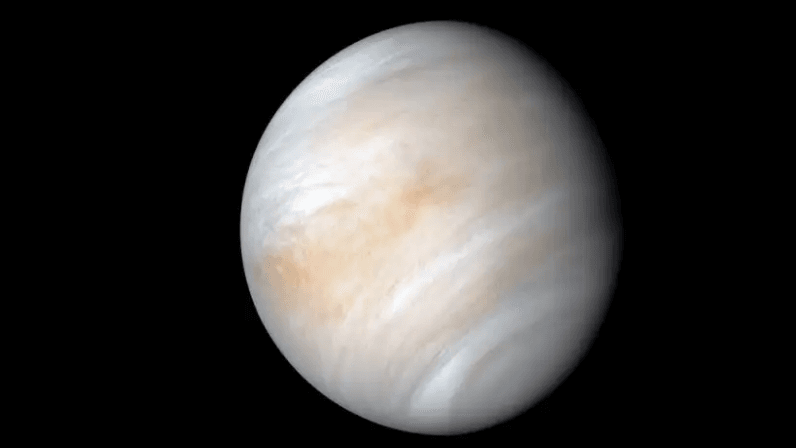
Venus through a telescope viewing is one of the first true planetary observations for many people. Not because Venus shows a lot of detail, but because it is extremely bright and shows distinct phases. That is precisely what makes Venus instructive: you see with your own eyes how a planet behaves differently from stars and how our solar system is put together.
Yet Venus often evokes confusion. If you expect craters, cloud structures or color details, disappointment follows. If you expect a bright disc that visibly changes shape, then Venus is a fascinating object.
What do you see when you view Venus through a telescope?
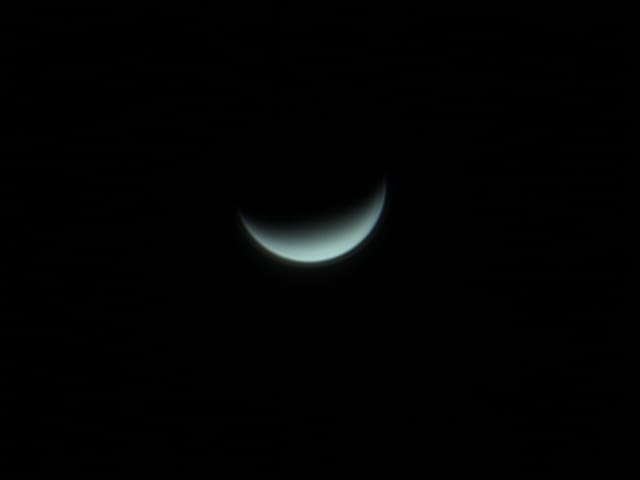
When you view Venus through a telescope, you don't see surface details like the Moon or Mars. Venus is completely enveloped in an extremely thick atmosphere of sulfuric acid clouds. These clouds reflect sunlight so strongly that the surface is completely hidden optically. What you actually see is a bright white to yellowish disc that, like the Moon, shows distinct phases.
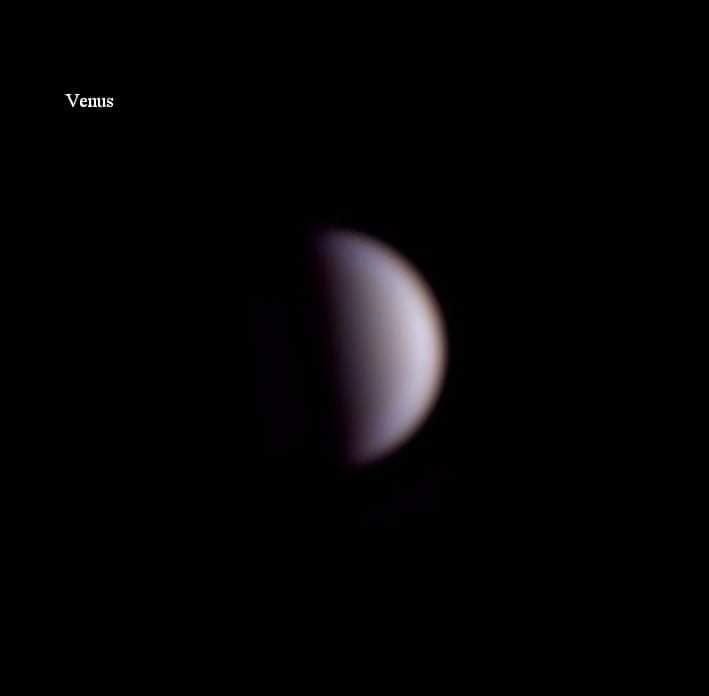
Depending on the position of Venus in relation to the earth and the sun, you can see her as a thin crescent, a half-disk or almost fully illuminated. This change of shape is not an optical trick, but a direct result of her orbit between the Earth and the Sun. Observing those phases is exactly what makes Venus so interesting, especially for novice observers.
With larger telescopes and calm skies, you can sometimes see subtle variations in brightness or a soft edge along the planetary disk. These are not actual cloud patterns, but atmospheric effects created by the thick, reflective cloud layer.
Why Venus through a telescope is so interesting
Venus today is an extremely hot world, with surface temperatures above 460 degrees Celsius. This makes it unlivable. Yet climate models suggest that billions of years ago Venus may have had a more moderate climate, with liquid water on its surface. A runaway greenhouse effect eventually turned the planet into the world we know today.
Precisely because Venus is very similar to Earth in size and composition, but has evolved completely differently, she is an important object of study for planetary research. That makes it extra special that you can simply follow her phases yourself with a telescope in your backyard.
Can you see Venus without a telescope?
Venus is highly visible to the naked eye and is known as the evening star or morning star. With an apparent brightness sometimes reaching magnitude -4.6, Venus is even the brightest object in the sky after the sun and moon. In exceptional cases, it is even visible during the day if you know exactly where to look.
Without a telescope, however, Venus always remains a bright point of light. Only with magnification can you see its shape and phases.
What telescope do you need to see Venus properly?
Venus makes relatively few demands on aperture, but all the more on control of brightness and magnification. With a telescope starting at about 60 millimeters of aperture, the phases are already clearly visible. Larger telescopes such as the Omegon 152/1200 do not show additional surface detail, but do make it easier to keep the shape sharp at higher magnification.
The biggest challenge with Venus is its extreme brightness. Without a filter, the image often becomes irradiated and you lose contrast. A moon filter or variable polarization filter helps to attenuate the light, making the phases quieter and sharper to see. This makes observing more pleasant and educational.
For Venus, a variable polarization filter the best, because it allows you to attenuate the extreme brightness in a controlled way and the phase becomes quieter and sharper visible. A UHC or OIII filter is not suitable here, because they are meant for nebulae and do not give an advantage with planets.
When is Venus most visible?
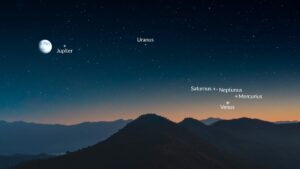
Venus is best observable around maximum elongation, the time when it is farthest from the sun in the sky. That happens roughly every 584 days. Around that time, Venus is higher above the horizon and the phase is clearly visible. Depending on the cycle, you will then see her in the evening or just in the early morning.
Exact visibility and elongation times are tracked by, among others NASA, whose data are publicly available.
Practical observation: what really makes a difference?
Venus observing is less about equipment and more about conditions. Quiet air, a well-cooled telescope, and moderate magnification yield more than zooming in ever higher. Always start with a low magnification to get the planet into view quietly and then increase step by step until the phase is clearly visible.
Precisely because Venus has little detail, it is an excellent planet to learn how seeing, focusing and filters affect the image.
Can you photograph Venus?
Venus is one of the easiest planets to photograph precisely because of its brightness. Even with a simple smartphone adapter, you can capture her crescent shape. In doing so, don't expect detail-rich images, but do expect a clear phase. With a planetary camera and stacking software, you can capture the shape more sharply, but again, Venus remains a planet of shape, not detail.
Venus through a telescope: what you learned
Viewing Venus through a telescope is not a spectacular show of detail, but an educational and surprisingly beautiful observation. You don't see a surface, but you do see clearly how a planet goes through phases and how our solar system is put together geometrically. With a simple telescope, a good filter and realistic expectations, Venus is an object you can follow again and again.
If you want to know which telescope is suitable for Venus as well as other planets such as Jupiter and Saturn, it is wise to look further in our stargazing buying guides. This will help you avoid false expectations and get more out of each observation.
 Dutch
Dutch English