
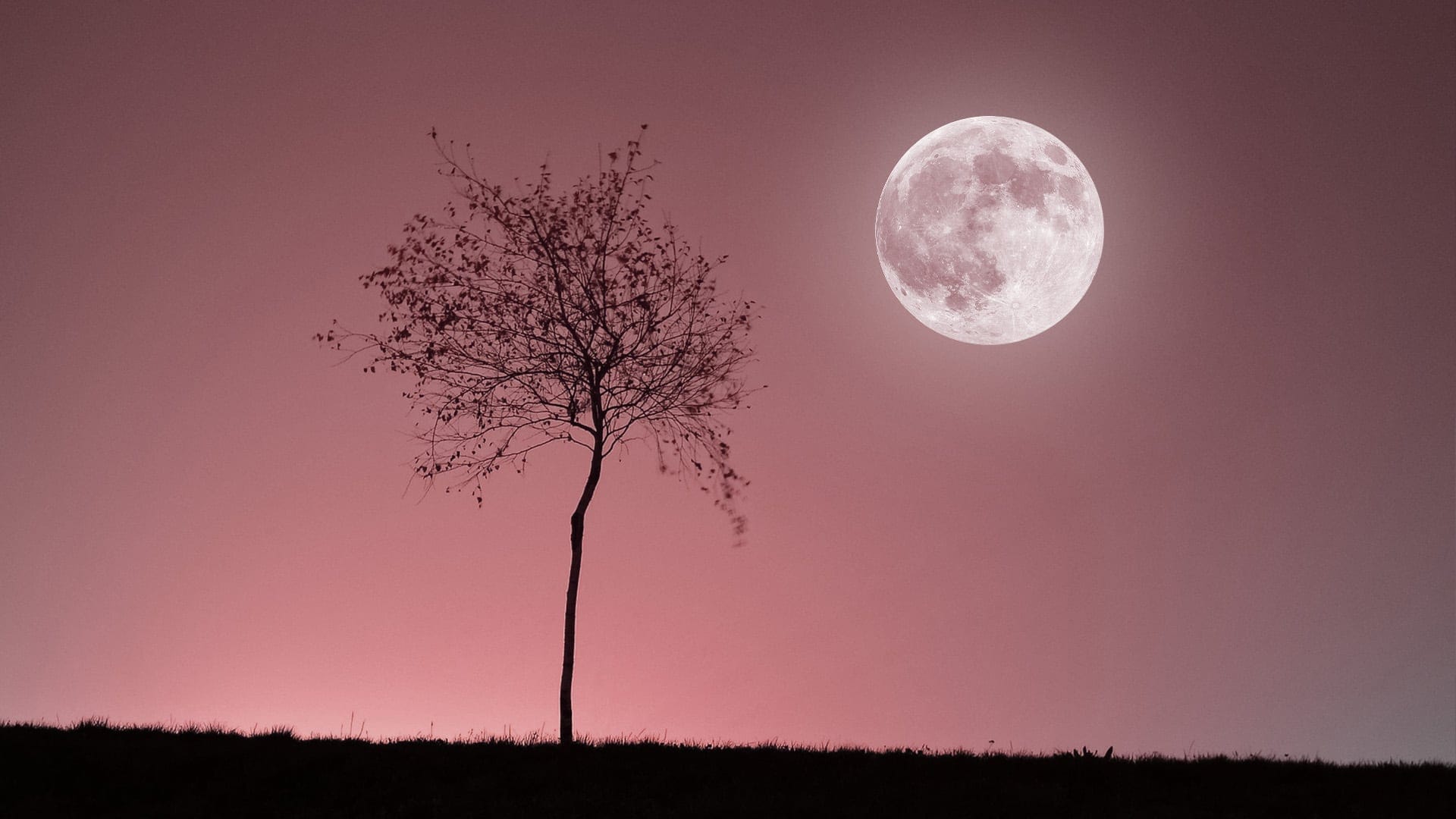
Want to get a good look at the April 2026 full moon? Then you need to pay attention to the timing. In astronomy, the moon is only ‘full’ at one exact moment, but to us, it looks like a large illuminated disk three nights in a row. In April, we call this the Pink Moon. Spoiler: it doesn't actually turn pink, but it is the moment when spring really begins and we set the date for Easter.
In this guide, we dive into the facts. What time should you be outside? Why do we call it that? And how do you make sure you see more than just a bright white spot through your telescope?
The facts at a glance (for the Netherlands and Belgium)
Courtesy of Starwalk.Space we have listed the facts:
| What do you need to know? | Details for 2026 |
| Date peak | Thursday, April 2, 2026 |
| Exact time (100% full) | 10:12 a.m. |
| Best time to watch | Evening of April 2 (from 8:15 p.m.) |
| Where is the moon? | In the constellation Virgo (Virgo) |
| Link to Easter | Defines Easter on Sunday, April 5 |
When should you be outside?
The astronomical peak of the full moon falls at 10:12 a.m. on Thursday, April 2, 2026. That's during the day, so you won't see much then. The moment you really have to see your binoculars must address is the evening of April 2.
Around 8:15 p.m., the moon rises in the east. This is often the best time for photographs. Because the moon is still low on the horizon then, it appears much larger than when it is high in the sky in the middle of the night. We call this the moon illusion. Your brain compares the moon to trees or houses on the horizon, making it seem like it is huge.
It is in the constellation Virgo that night. If you look closely, you'll see a bright dot near the moon: that's Spica, the brightest star in that constellation. With a simple beginner telescope you can often even get them both in view at the same time.
Why is it called the Pink Moon (no, it does not turn pink)?
Let's dispel that fable immediately: the moon does not turn pink on April 2. The name comes from the ‘Wild Ground Phlox,’ a little pink flower that is one of the first to bloom in spring in North America. Native tribes used this type of natural phenomenon to keep track of time.
In Europe, we often used to call this moon the Grass Moon or the Egg Moon. The latter makes sense because this moon determines when we celebrate Easter. The rule is: Easter falls on the first Sunday after the first full moon of spring. Since the moon is full on Thursday, April 2, we celebrate Easter three days later, on Sunday, April 5.
So without this moon, we had no idea when to have Easter brunch. Want to learn more about how the phases of the moon affect our calendar? Then check out the sites of NASA Whether the ESA.
Viewing the Moon: Avoid being blinded
Many people who buy a telescope for the first time make the same mistake: they point it at the moon during the full moon and are shocked at how bright the light is. The moon reflects buckets of sunlight. Without protection, all you really see is a bright white spot and your eyes get sore after a minute.
Use a moon filter
If you really want to see details in the craters, you have a moon filter needed. This is basically a pair of sunglasses for your telescope. You simply screw the filter onto your eyepiece and it attenuates the bright light. As a result, you suddenly see contrasts you would never have seen otherwise. You suddenly see the halo around crater Tycho (those white stripes running across the moon) and the mountain ranges razor sharp.
Which telescope do you choose?
- Do you want sharpness? Then go for a lens telescope, also called a refractor mentioned. These give a very calm and high-contrast image of the moon.
- Want to see more objects? A Newton telescope with a larger mirror catches more light, which is nice if you want to look at a planet or galaxy after the moon. Deep-sky objects are not recommended, as the full moon creates a lot of light pollution.
Our choice for the full moon of April 2026
If you ask us which telescope you need to have to see the Pink Moon (and the rest of the night sky) really well without immediately spending thousands of dollars, we almost always end up with the Sky-Watcher Heritage 130/650 FlexTube.
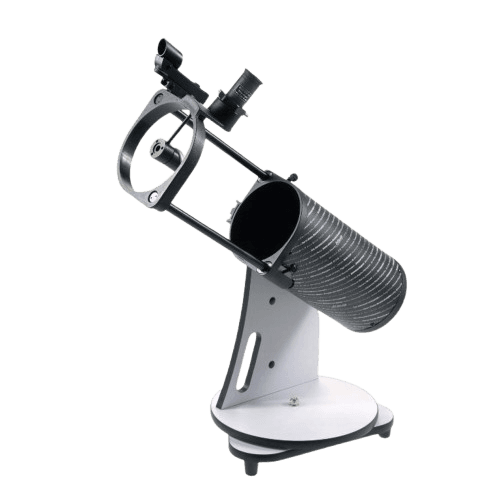
Why this is our favorite? Because it simply offers the best balance between ease of use and optical quality.
- With a mirror of 130mm captures enough light for this telescope to see not only the craters on the moon in razor-sharp focus, but also to spot details on Jupiter and Saturn's rings.
- You can slide the telescope in. This makes it super compact and you can easily take it with you to a dark place outside the city.
- It's a ‘Dobson’ telescope. That means you put it on a table or on the ground, look through the viewfinder and can start right away. No hassle with complicated tripods that you have to level first.
For the April full moon, we recommend combining this telescope with a good moon filter. Because the 130mm mirror catches so much light, the moon is actually quite bright in this scope. With this set-up, you're all set for years of viewing pleasure at once.
👉 Check out the Sky-Watcher 130/650 FlexTube on Telescoop.nl
Technology: What's going on up there?
The moon orbits the earth in 29.5 days. During full moon, the earth is exactly between the sun and the moon. The sunlight then falls straight on the front of the moon. This is why during full moon you see almost no shadows in the craters.
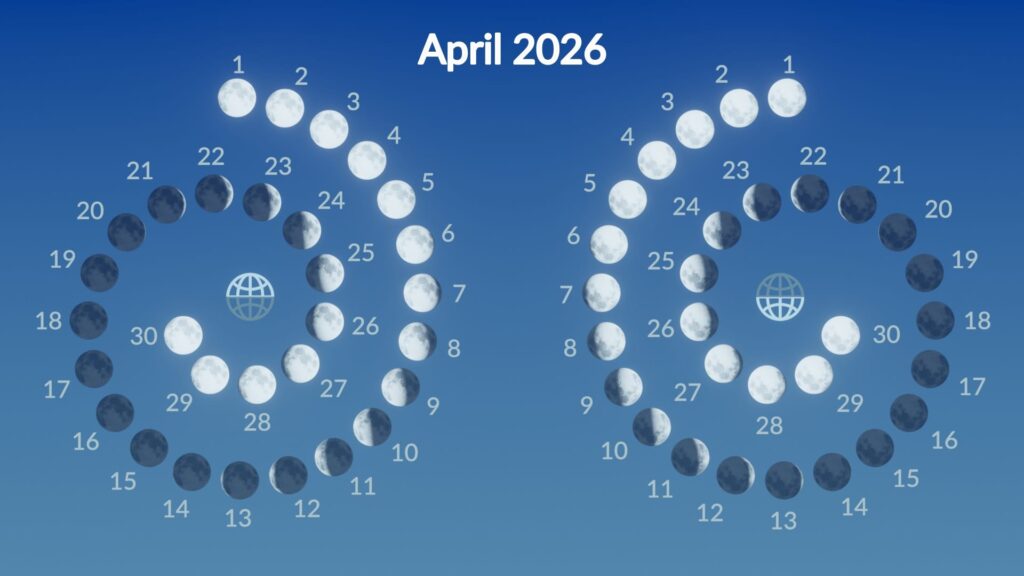
On the contrary, if you do want to see those deep craters, it is best to look a few days before or after April 2. For example, March 25 is First Quarter. The sun then shines from the side, causing the mountains to cast long shadows on the moon. This gives a much more dramatic image through your viewer. For an overview of all these phases, you can view the lunar calendar of StarWalk Space view.
Photographing the moon with your smartphone through a telescope
You don't have to have a professional camera to capture the Pink Moon. Most modern smartphones can do this just fine, provided you get a little help.
The biggest problem is vibration. If you hold your phone with your hand in front of the eyepiece of your telescope, nine times out of ten the picture will be blurred. A smartphone adapter solves this. You clamp your phone to the telescope, focus and use the 2-second timer to take the picture.
Pro-tip for your photo: Tap the moon on your screen and slide the sun (exposure) all the way down. This will prevent the moon from becoming a white spot and you will see the gray details of the lunar seas reflected in your photo.
Frequently asked questions about April 2, 2026
What time does the moon rise in the Netherlands?
On April 2, it rises around 8:15 p.m. Find a spot where you have a clear view to the east, as it is very low at first.
Is this a supermoon?
No, the moon is at a normal distance from Earth. So it is not extra large, but because of the bright spring sky, it is still impressive.
Do I need an expensive telescope?
Definitely not. The moon is the easiest object to view. Even with a simple model of a few tens you can see the craters. Want real detail? Then look at the Omegon Dobson 203/1200 (a true telescope for life).
What is the next full moon?
That's the Flower Moon on May 1, 2026. Fun fact: May 2026 has two full moons, the second one we call a Blue Moon.
The full moon of April 2026:
The full moon of April 2, 2026, is the time to dust off your equipment once again. Whether you just watch the rise with a beer in the garden or go all night counting craters with a moon filter on your scope, the Pink Moon never disappoints.
Be ready on time (8:15 pm!) and don't forget to charge your phone if you want to take pictures. Need another filter, adapter or maybe a better scope for this year? Then check out our selection at Telescoop.nl. Our experts will help you make the right choice, so you're not just staring at a white spot, but really looking out into space.
 Dutch
Dutch English