
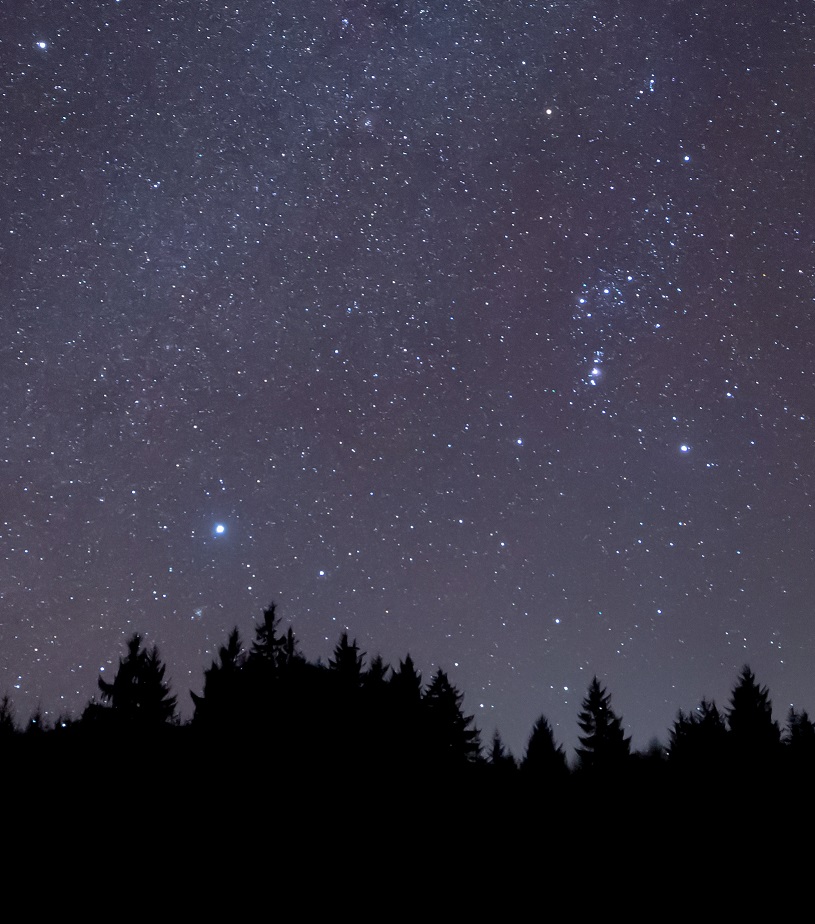
The starry sky of January 2026: recognizable, and lots happening!
The starry sky January 2026 brings one of the most recognizable celestial scenes of the year. As soon as darkness falls, a backdrop forms that almost every stargazer instinctively recognizes: Orion to the south, the Pleiades high in the east, Auriga and Gemini above you, and in the west the retreating autumnal system Pegasus. Because hardly anyone knows all the positions by heart (only very experienced astronomers), a free planetarium software such as Stellarium (https://stellarium.org/) ideal: set your location wherever you are and you can see exactly what is currently above you.
In the west, the Pegasus-square slowly toward the horizon. Just above it is the area of the Andromeda Nebula (M31) our neighboring galaxy. It looks like a vague haze, but in a telescope suddenly becomes an elongated nebula. If you want to know what Andromeda looks like through a telescope, click here.
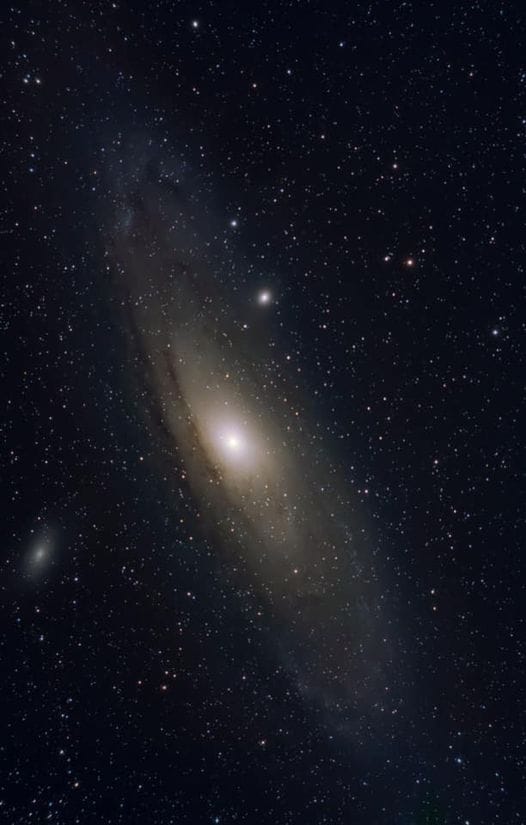
With a smart telescope even spiral structures appear; live stacking makes it possible to still see deep sky objects from urban settings. For many beginners, M31 is the first moment when they realize they are not looking at a star, but at an entirely different galaxy.
Orion, Taurus and the winter stars in the sky January 2026: why this month has so much to offer
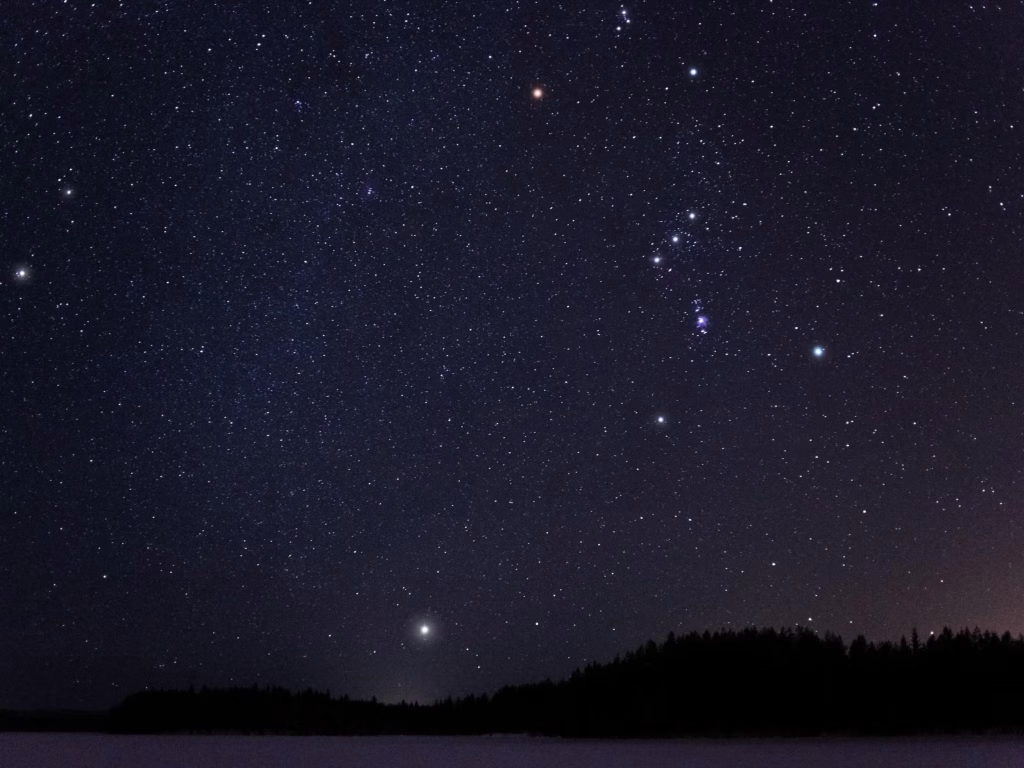
The heart of the winter sky is formed by Orion, Taurus (Taurus), Carter (Auriga) and Gemini (Gemini). Together they form a cluster of bright stars that remains visible even under moderate light pollution. Orion is the easiest to spot: three stars in a row form its belt, Betelgeuze colors red-orange in the upper left, and Rigel radiates blue-white in the lower right. Those who have never looked through a telescope will find a perfect starting point in Orion.
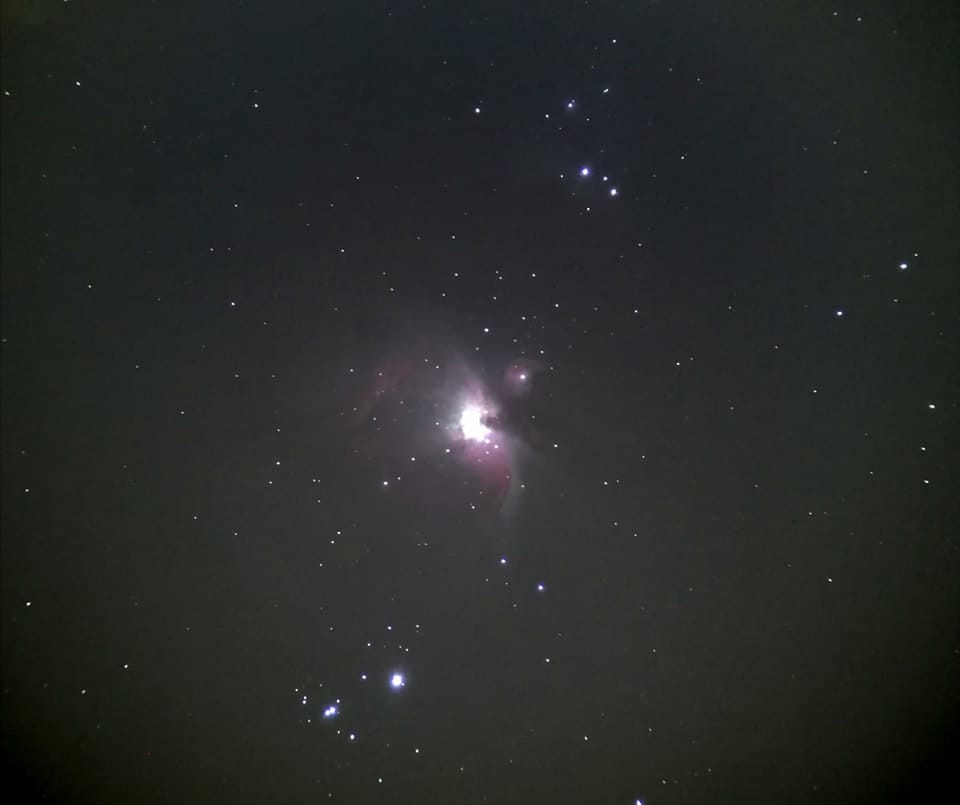
Under the belt of Orion hangs the Orion Nebula (M42), a star-forming region 1,760 light years away. Even in a small telescope, the nebula is recognizable as a soft spot; in a classic 130-150 mm Dobson, it becomes a cloudy landscape with slight texture. If you want to see what Orion looks like through a telescope, click here. Smartscopes immediately reinforce this: stacking short exposures creates within seconds an image you normally only see in photography books. It is exactly this kind of experience that often makes beginners decide to buy their first telescope.
Above Orion stands Taurus, with the striking orange giant in the middle Aldebaran. Around Aldebaran you can see the star group Hyades, an open cluster shaped like a large V. A little further away are the Pleiades (M45), a compact cluster that is already beautiful with the naked eye, but really starts to sparkle with a small telescope. The blue glow seen in photos is actually too weak with a telescope, but the fine star structure is all the more impressive.
Further up stands Carter (Auriga), which contains three open clusters: M36, M37 and M38. M37 in particular is remarkably star-rich and already shows in a simple telescope how diverse open clusters can be. A little further east you will find Gemini (Gemini) with the famous stars Castor and Pollux. Castor is a beloved binary star: even a small telescope splits it into two components.
All these constellations combine to form the winter star field that feels like home to many stargazers. It is bright, uncluttered ánd rich in deep-sky objects, exactly the combination that makes the January 2026 starry sky so attractive.
Planets in January 2026: Jupiter shines, Saturn gives small show
Not every planet is favorable in January 2026, but the planets that are visible make up for a lot. Jupiter dominates the evening sky with a magnitude around -2.7 and is in Gemini (Gemini). It rises as early as sunset and remains visible throughout the evening. Even with the smallest telescope you can see the four Galilean moons and the main cloud bands. Galileo did it too, so surely you can do it too right? 😉
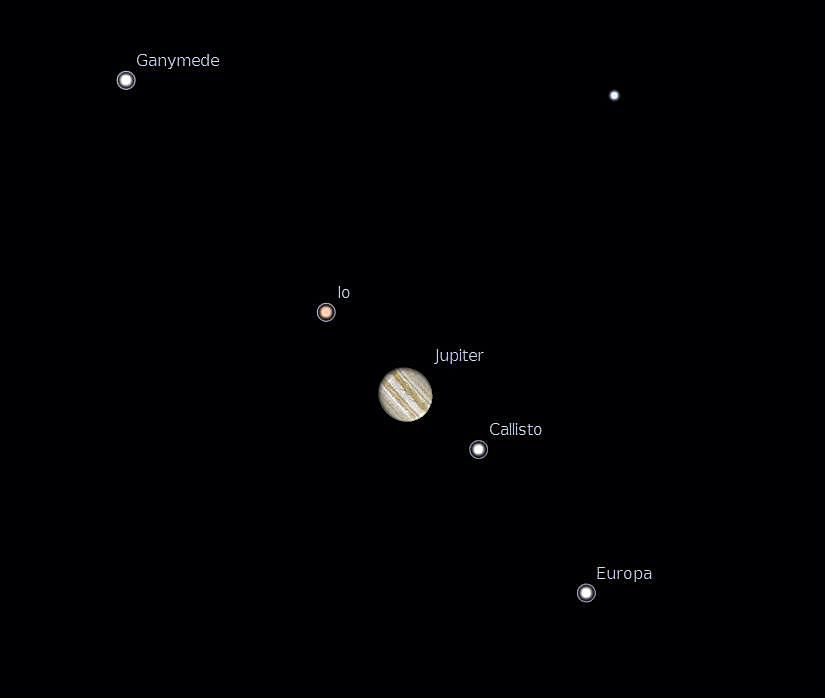
With a smart telescope, the details appear automatically on the screen; you immediately see why Jupiter is such a popular object for beginners.
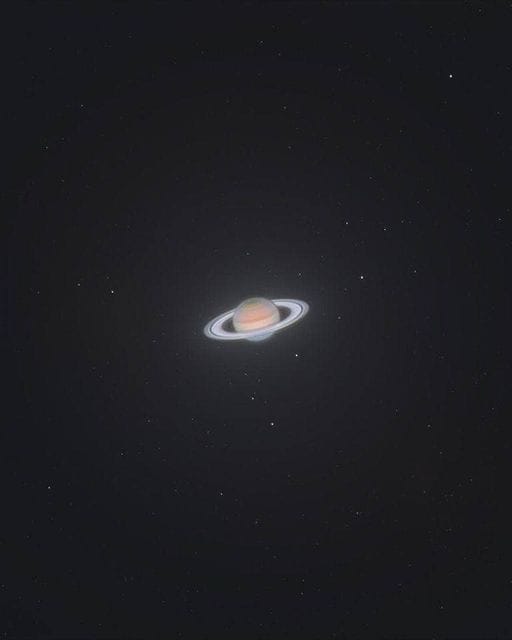
Saturn, in the constellation Fish, is much lower and drops below the horizon around 10:00-23:00 p.m. during the month of January 2026. This makes the observation windows shorter, but the rings are instantly recognizable even at low magnifications. In a 70-90 mm telescope, you can see the rings as a clear structure; with larger telescopes, moons and shadows are added. Saturn disappears quickly after sunset, so this is the month to catch it. Want to know what Saturn looks like through a telescope? Read it here!
Venus and Mars are too close to the sun this month to be visible. Mercury is also not conveniently placed. This naturally shifts attention to deep-sky objects, exactly what the winter sky is known for.
Starry sky January 2026: Moon phases, Quadrantids meteors and best time to watch
The month begins with a full moon on january 3, which is favorable for lunar observation, but inconvenient for deep-sky. The full moon coincides exactly with the peak of the Quadrantids, one of the strongest meteor showers of the year. Under ideal conditions, 60-120 meteors per hour are possible, but due to the bright moonlight, especially the brightest ones become visible. Those who still want to try should go out around 4 a.m., when the radiant is higher and the night is darkest.
Round Jan. 18 is the new moon, the best time for the Andromeda Nebula, the Double Cluster in Perseus and the clusters in Carter. For galaxies and nebulae, the principle works simply: the darker, the better. Many people notice for the first time during a new moon how far a 130-150 mm telescope can actually reach. Smart telescopes also benefit extra from dark skies: their sensors pick up subtle contrast differences better.
The moon itself remains the most rewarding object for beginners. Immediately after the full moon, the terminator, the boundary between light and shadow, slides across the brightly lit craters. This produces spectacular depth effects, even at low magnification. Almost everyone who buys a telescope eventually starts moongazing, because without preparation it is immediately impressive.
What you need for stargazing January 2026
The winter sky works in favor of anyone who wants to start stargazing. With the naked eye, you can see Orion, Pleiades, Hyades and Sirius. With binoculars, clusters and nebulae come to life. And with a telescope, classic or smart, January 2026 will be one of the most rewarding months of the year. So good start!
Those who prefer to observe without fuss often choose a smart telescope: which automatically looks up objects and displays nebulae and galaxies in real-time stacking. Those who prefer the classic observation should choose a 130/650 or 150/750 Dobson, a telescope that you set up in a minute and is perfect for this winter season.
Whichever route you choose: with Stellarium at hand and a January dark night ahead, this is the month when many people discover just how rich the night sky really is.





 Dutch
Dutch English