
What makes the February 2026 planetary alignment so special?
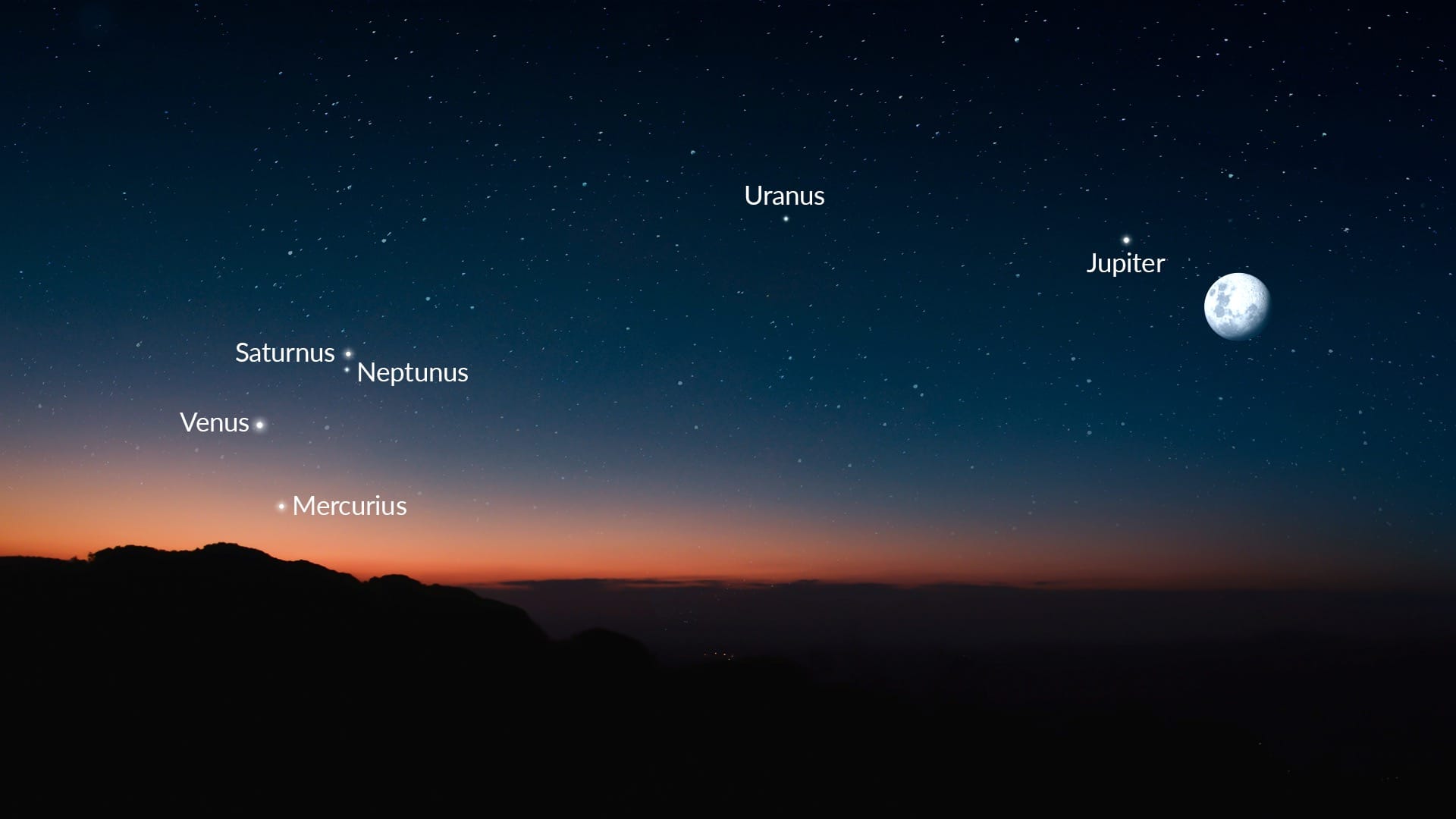
The February 2026 planetary alignment is one of the most striking planetary conjunctions of this decade. On and around Feb. 28, 2026, six planets are on the same side of the Sun at the same time, making them appear in the evening sky, as seen from Earth, within one wide arc.
What makes this alignment exceptional is not only the number of planets (six), but especially the fact that four of them are visible to the naked eye: Venus, Mercury, Jupiter and Saturn. Uranus and Neptune also participate, but require optical aids. Check out our blog series ‘through a telescope’ here’ To see what the planets look like through a telescope!
This is exactly the type of astronomical phenomenon that appeals to beginners and experienced observers alike: visually appealing, relatively easy to observe and excellent for understanding how our solar system works.
Which planets are participating in the February 2026 planetary alignment?
During the February 2026 planetary alignment, the following planets can be seen:
- Mercury
- Venus
- Saturn
- Neptune
- Uranus
- Jupiter
Four of them are bright enough to see without aids. Mercury and Venus are low above the horizon, while Jupiter and Saturn can be found higher in the sky. Uranus and Neptune are much fainter and only stand out if you know where to look.
Moreover, the moon is illuminated for about 90% during this period and is close to Jupiter, which makes the whole thing even more impressive visually but also makes the contrast for fainter objects slightly more difficult.
Where and when can you see the February 2026 planetary alignment?
The February 2026 planetary alignment is visible in the evening, roughly about an hour after sunset. This is crucial: those who look too early will not yet see Mercury and Venus; those who look too late will already miss them below the horizon.
The date Feb. 28, 2026 is an average. Depending on your location, the optimal observation night may be a little earlier or later:
- South America: around Feb. 25
- Central Europe (such as the Netherlands and Belgium): Feb. 28 - March 1
- Northern Europe: 1-2 March
A clear view of the western horizon is essential because Mercury and Venus are very low. Tall buildings, trees or hills can completely block the view.
What do you see in the sky during planetary alignment?
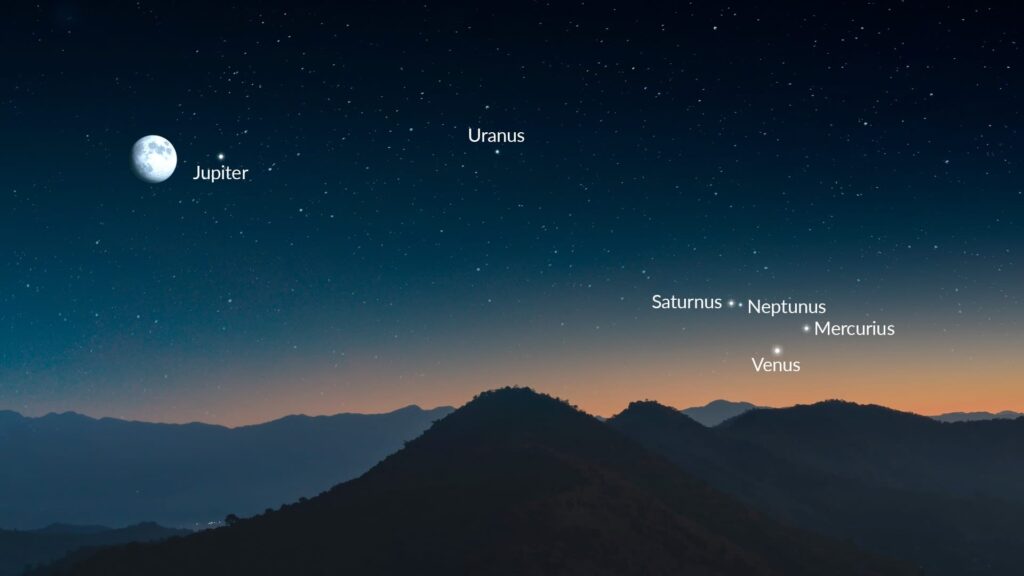
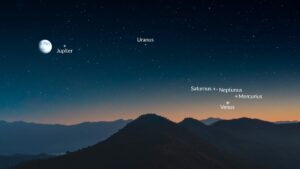
The bottom images show How the alignment looks in the sky. You can clearly see that the planets do not form a perfect straight line, but follow an arc. This is because they are moving along the ecliptic are located, the plane in which almost all the planets move around the Sun.
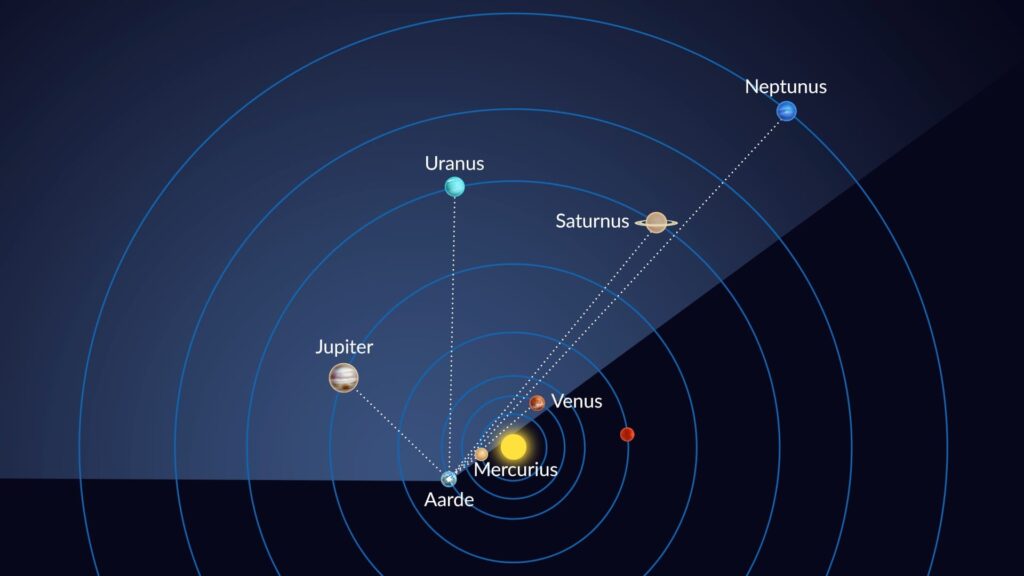
This image shows something quite different: the actual position of the planets in the solar system. Here it immediately becomes clear why the word “alignment” is actually misleading. In space, the planets are not neatly aligned at all; they are simply on the same side of the Sun.
This difference between appearance and reality is very important to properly understand the February 2026 planetary alignment.
What exactly is a planetary alignment?
A planetary alignment is not an officially defined astronomical event with rigid rules or fixed criteria. Rather, it is a practical term which is used to describe a situation in which several planets are in the same part of the sky at the same time, or viewed from above the solar system are roughly on the same side of the Sun.
That distinction is important because the two meanings are often confused. A spatial alignment says something about the position of planets in the solar system itself, while a visual alignment is mainly about what we see from earth. And the two do not coincide by a long shot.
So something special happens in February 2026: several planets are not only on the same side of the Sun, but also appear within one wide arc in the evening sky. As a result, this conjunction feels much more impressive to observers than many other alignments that exist only “on paper.”.
During the 2026 planetary alignment, do the planets form a true straight line?
Although the word “alignment” could mean that planets are neatly aligned one after the other, like beads on a string, in reality this is impossible. The planets all revolve around the Sun in their own orbits, and those orbits do lie roughly in the same plane, but never exactly.
Each planetary orbit differs slightly from the others. Sometimes this is barely noticeable, sometimes a little more, but it means that there are always small differences in altitude. Even when planets all happen to be on the same side of the Sun, they do not form a perfect straight line in three dimensions.
So what we call a planetary alignment is not a cosmic ruler, but a convenient human tag for a situation where the planets happen to be favorably positioned for observation from Earth. That way we can just understand it better 🙂
Is a planetary alignment the same as a planetary parade?
The terms planetary alignment and planetary parade are often used interchangeably, but they do not mean the same thing.
A planetary alignment refers to the mutual position of planets: they are close together in the sky or on the same side of the Sun. It is a geometric concept, though informal.
A planetary parade, on the other hand, is a loose, non-scientific term. By this, one usually means that several planets are visible in one night, regardless of how close they actually are. It is more about the experience than the exact configuration.
The February 2026 planetary parade meets both descriptions. There is a true conjunction as well as an evening when a remarkable number of planets are visible. That explains why this alignment is getting so much attention.
How can you observe all the planets during the February 2026 planetary alignment?
For many people, it just starts with looking. Venus and Jupiter stand out almost immediately; they are the brightest “stars” in the sky and act as natural landmarks. Saturn is less noticeable, but has a quiet, yellowish appearance that distinguishes it from the twinkling stars around it.
Mercury requires a little more attention. It is low above the horizon and only visible for a short time after sunset. Those who look too late simply miss it!
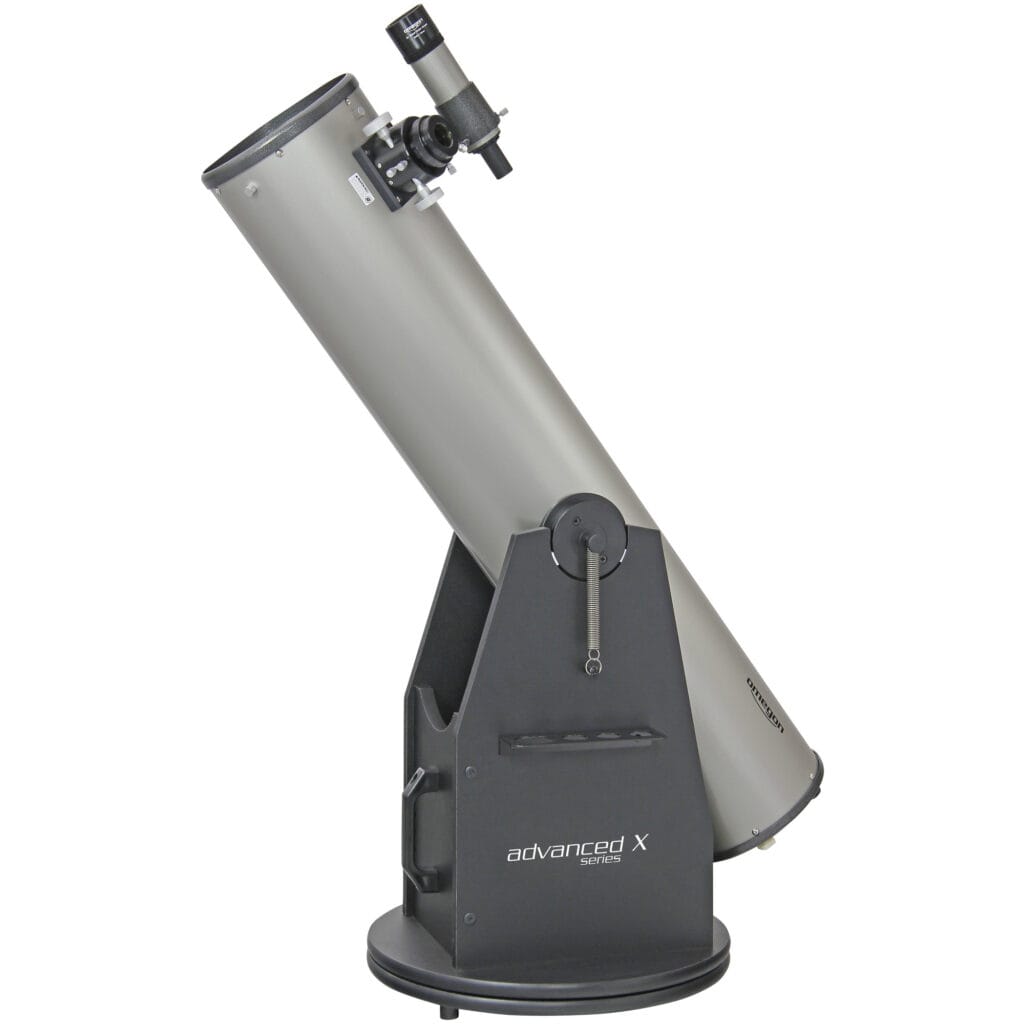
Uranus and Neptune are a different story. They are dim and inconspicuous. You can't see them with the naked eye, and even with binoculars they remain tiny points of light. A telescope such as the Omegon Advanced 203/1200 Especially helps in being sure you are looking at a planet, and also in seeing details.
What actually changes when multiple planets are close together?
A planetary alignment doesn't change anything about the earth itself, but it does change the way you experience the sky. Normally, planets are scattered throughout the night. Some appear late, others disappear early, so you can rarely compare them in one observing session. Things are different during the February 2026 planetary alignment: multiple planets are in the same part of the sky at the same time, within a relatively short window of time after sunset.
This makes this evening particularly suitable for not only seeing planets, but also understanding them. When Venus, Jupiter and Saturn are visible more or less simultaneously, the differences are suddenly striking. Venus looks bright and sharply defined, Jupiter dominates by its brightness, while Saturn appears calmer and more yellowish. These differences are always there, but only really become apparent when you see them almost side by side.
In addition, alignment helps tremendously with orientation. Once you see one planet, you know where to look for the next one. For those with little stargazing experience, this lowers the threshold considerably. You don't have to guess or doubt whether you are looking at the right object; the sky “points” itself, so to speak.
What can you see during the February planetary alignment?
The February 2026 planetary alignment is not a time when planets suddenly become more spectacular than usual. What changes is not their appearance, but the context in which you observe them. With the naked eye, you see bright points of light that are distinguished from stars by not twinkling and moving along one solid line. With binoculars, that difference becomes even clearer, especially with Jupiter and when locating the fainter planets.
A small telescope mostly adds confirmation. Jupiter shows its moons and sometimes band structure, Saturn shows its rings, but Uranus and Neptune remain small discs without detail. This is not a disappointment, but simply a consequence of distance and scale. The value of this evening is not in detail observation, but in overview and comparison.
Why this is a special night for everyone
Many people start stargazing by looking up single objects: a planet here, the moon there. What's often missing is the larger connection. The February 2026 planetary alignment brings that connection together....
You see how planets move along the ecliptic, why they are never randomly scattered across the sky, and why some planets always stay close to the horizon while others rise higher. Concepts that normally remain abstract automatically become logical during such an evening. You don't have to memorize them; you see them happen. You look up things you hadn't looked up before!
This is why these types of conjunctions are often used as entry points into the astronomy. Not because they are rare or mysterious, but because they provide insight into how the solar system is actually constructed.
Why this 2026 planetary parade is more special than many others
Planetary alignments occur more often than is often thought, but rarely do conditions coincide as favorably as in late February 2026. This is mainly due to visibility. Mercury is usually hard to see, many conjunctions take place in the early morning, and often only one or two planets are really bright.
This alignment takes place in the evening, with several planets visible without tools. This makes it not an event for which you have to pull out all the stops, but something you can actually experience even without experience.
The 2026 planetary alignment: our final summary words
The February 2026 planetary alignment is especially interesting because several planets are visible within the same part of the sky in one evening. This makes it possible to directly compare their brightness, position and behavior.
For those who want to learn to recognize and understand planets, this is a practical observational moment: you'll see why planets move along the ecliptic, why they don't sparkle like stars, and why some planets always stay close to the horizon.
So the value of this planetary alignment is not in spectacle, but in overview and insight ... something that rarely comes together as clearly as it did in late February 2026.





 Dutch
Dutch English