
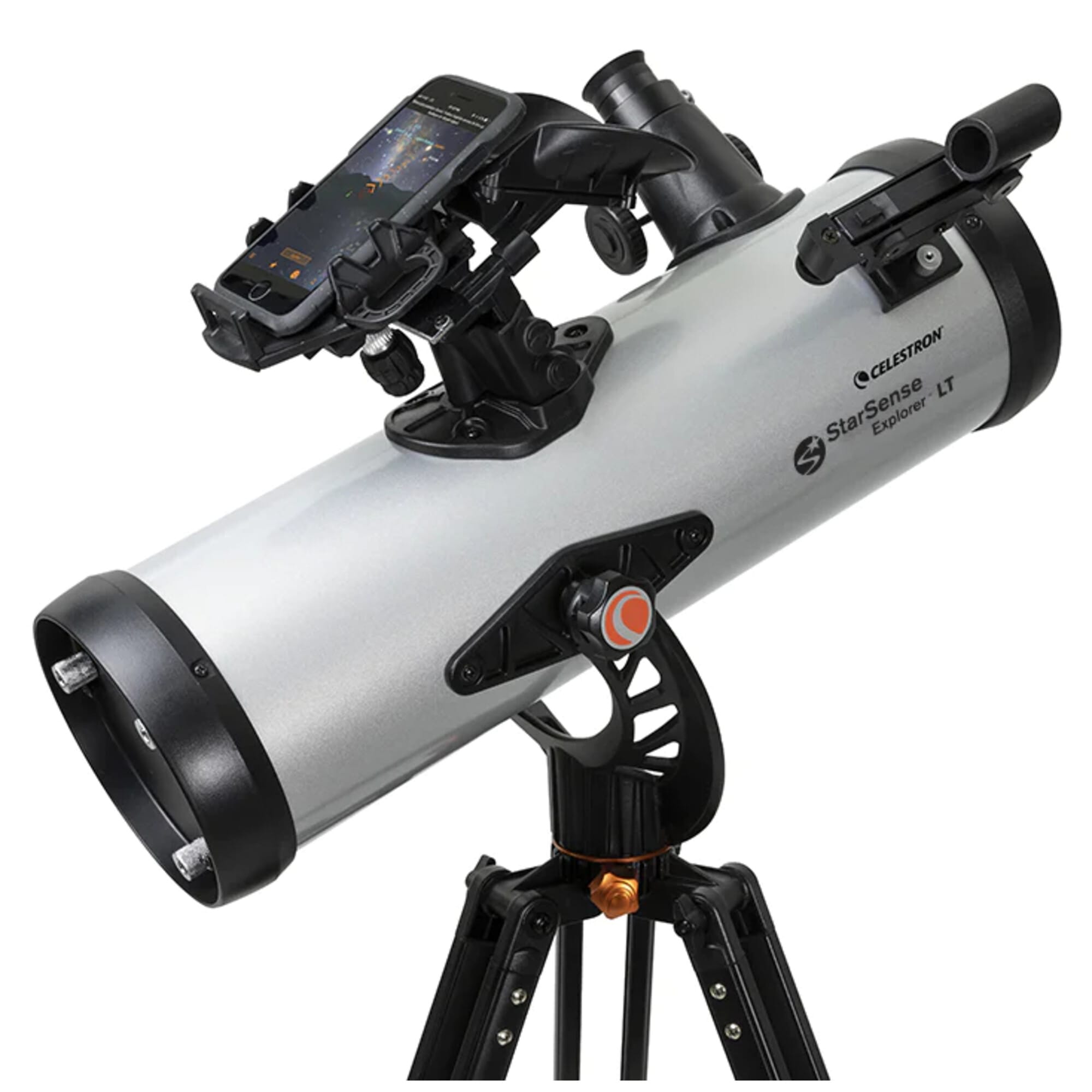
Anyone who steps into the world of astronomy cannot avoid Celestron. Walk into any observatory or flip through any trade magazine, and you'll see those iconic orange tubes. But let's face it: the choice these days is so huge that you can't see the forest for the trees. At Telescoop.nl we get the question every day: “Is Celestron worth the extra cost, or am I paying for the name?”
In this comprehensive analysis, we break down the entire Celestron range to its core. No whipped up marketing stories, but a deep dive into what you really get for your money. We look at the technology, the optical performance and perhaps most importantly, the frustrations you're going to encounter. Because yes, even with the best telescopes from Celestron is not always rosy.
The Celestron ecosystem: More than just glass and metal
Before we look at the specific models, we need to understand why Celestron dominates the market. Since the 1960s, they have understood one thing very well: the average person is not a doctor of astrophysics. Most people just want to see the rings of Saturn on a Saturday night without first spending three hours struggling with a complicated mount.
Celestron has divided their offerings into “worlds.” Each world is intended for a specific type of observer:
The Convenience Explorer (StarSense Explorer): Uses technology to hack the search process.
The Apprentice Astronomer (AstroMaster): Want to learn the classic way, with all the trial and error that comes with it.
The Luxury Observer (NexStar): Want the telescope to turn to Mars at the push of a button.
The Photographer (EdgeHD): Accepts nothing less than optical perfection down to the corners of the image.
Let's start with the biggest innovation of recent years that has fundamentally changed the hobby for beginners.
The StarSense Explorer: Finally a solution to search!
Let's sketch a scenario that every beginner recognizes. You're in the garden, it's freezing cold, and you're trying to find the Orion Nebula. You look at a star chart, then through your finder, then at the chart again. After an hour, you still haven't found anything except a few random stars you can't place. The telescope goes back in the box and ends up in the attic.
This is exactly where the Celestron StarSense Explorer series jumps in. It is not a “GoTo” telescope (which moves by itself), but a “Push-To.” The difference? You move the telescope, but the software tells you exactly where to go.
The technology: LISA is not Siri
The heart of this system is the StarSense app. Many people think the app simply uses your phone's compass and gyroscope (like apps like SkySafari or Stellarium), but that's not true. In fact, those sensors in phones are far too inaccurate for a telescope.
StarSense uses a technique they LISA (Lost In Space Algorithm). Your phone's camera looks at the stars through a mirror on the telescope. The app recognizes the patterns of the stars and therefore knows to the second of arc where the telescope is pointing. It's the same technology satellites use to orient themselves. The beauty? It works completely offline. No need for 4G in the dark field.
Which StarSense should you have (and which not)?
Within this line there is quite a difference in quality. You can find them all on the Celestron page of Telescoop.nl, but pay attention to the details:
The LT models (70AZ and 80AZ): These are refractors (lens telescopes). They are light and cheap, but the tripod is on the skinny side. For children or if you are really on a tight budget, they are fine, but don't expect miracles at high magnifications. The vibrations can be a nuisance.
The DX 102AZ: This is a serious step up. A 102mm refractor captures quite a bit of light and sits on a much more stable tripod with fine adjustment. In our opinion, this is the “sweet spot” for those who want to watch moon and planets from the city.
The DX 130AZ: For fans of nebulae and star clusters. This is a mirror telescope (Newton). With an aperture of 130mm, the sky really begins to “open up.” The Orion Nebula shows structure, and under really dark skies you begin to suspect the spiral arms of the Andromeda galaxy.
The honest critique of StarSense
Is it perfect? No. The app eats battery (bring a power bank). Plus, you depend on your smartphone's camera; if you have a budget five-year-old phone with a mediocre camera, the app will have trouble recognizing the star patterns. But when it works, the threshold to go looking is lower than ever. You'll see more in one evening than a traditional beginner sees in a month. Also, the tripod is not too sturdy.
The Celestron AstroMaster: The school of impatience
If the StarSense is the “Tesla” among entry-level telescopes, then the AstroMaster the manual off-road vehicle. There is no app on it. There are no motors on it. You are on your own.
Many web shops sell the AstroMaster as the “ideal beginner's scope.” We are at Telescoop.nl a little more careful about that claim. Why? Because the AstroMaster forces you to learn. If you are not prepared to understand what an equatorial mount is, you are going to have a fight with this telescope.
Why torment yourself with an EQ mount?
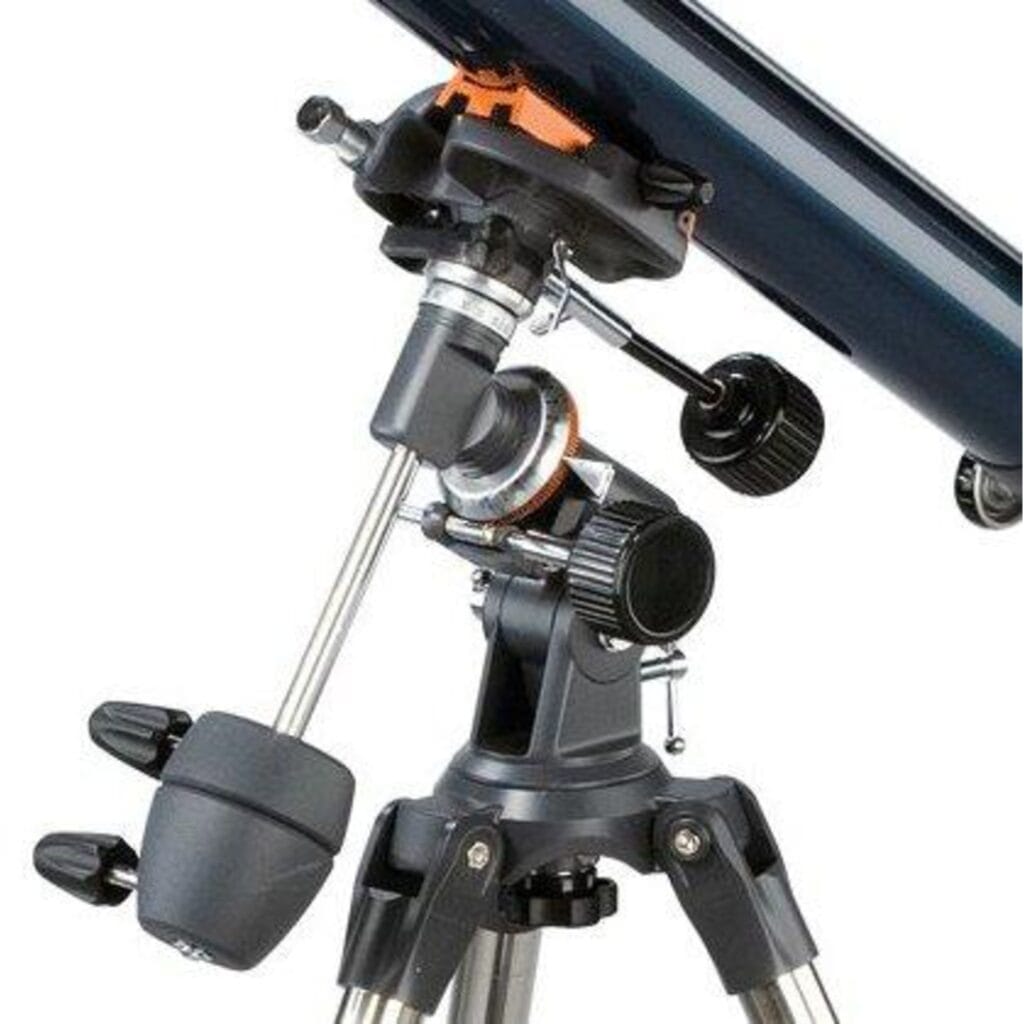
Most inexpensive telescopes move like a camera tripod: up-down, left-right (Alt-Azimuth). This is intuitive, but the stars do not move in a straight line along the sky; they arc.
The equatorial mount (EQ) of the AstroMaster 130EQ or 114EQ is angled, parallel to the Earth's axis. Once you have it properly aligned to the Pole Star, you only need to turn one knob to track a planet as the Earth rotates. That's gold if you're watching with a group or want to get started with simple smartphone photography of the moon.
The 130EQ: A workhorse with an edge
The AstroMaster 130EQ is one of the best-selling telescopes worldwide. And for good reason. The optical tube is fantastic for its price. The 130mm mirror is large enough to provide years of enjoyment.
But be critical of the accessories. Celestron often includes two eyepieces (20mm and 10mm). Those are “okay” to start with, but they don't get the most out of the telescope. The included viewfinder (the ‘red dot finder’) is often plastic with the AstroMaster series and can sometimes be a bit difficult to align. Our tip: invest immediately in a set of better eyepieces through our accessory section. The difference in contrast and sharpness will amaze you.
Who is the AstroMaster for?
The AstroMaster is for the observer who wants to be proud of his find. There is a specific satisfaction in manually locating the planet Saturn after a search with a star atlas. It trains your eyes and your spatial awareness. If you don't have that discipline and just want to see something “now,” stick with the StarSense or look at the NexStar series.
Automatic telescopes and the switch to Celestron GoTo
When you have mastered the basics of stargazing, or if you simply don't have the time to search manually, you turn to Celestron's automated telescopes. Colloquially, we call these GoTo telescopes. Whereas with the StarSense series you still have to push yourself, a GoTo system does everything for you.
The Celestron NexStar SE: The world's best-selling GoTo telescope
If you're looking for a Celestron, you can't avoid the ‘orange tube. The NexStar SE Series is an icon. At Telescoop.nl we see that the NexStar 8SE and the 6SE in particular are wildly popular. Why? Because of the optical design: the Schmidt-Cassegrain.
A Schmidt-Cassegrain combines mirrors and lenses. This provides a huge focal length (lots of magnification possible) in a very compact tube. For example, the NexStar 8SE has a focal length of a whopping 2032mm, while the telescope itself is less than 50 centimeters long. This makes it the ideal scope for people who want a lot of power but don't have the space for a huge tripod.
How does automation work? The NexStar uses SkyAlign. You point the telescope at any three bright objects in the sky. The internal computer then calculates where it is. Then you choose on the hand controller from a database of 40,000 objects. Want to see the Ring Nebula? One press of a button and the motors spin the telescope to it flawlessly.
Critical tip from our experts: A GoTo telescope eats power. Although it can take batteries, for the NexStar series we always recommend an external Celestron PowerTank on. There is nothing more annoying than a telescope that stops tracking mid-evening because the AA batteries are dead from the cold.
The NexStar Evolution: The next step in ease of use
For those who still find the regular SE series too much “hassle” with cables and separate controllers, Celestron has the NexStar Evolution developed. This is currently one of the most advanced consumer telescopes on the market.
What makes the Evolution different is its built-in lithium-ion battery and Wi-Fi. You no longer need a handheld controller; you pair your tablet or smartphone with the telescope and use the SkyPortal app to navigate the universe. The tripod is also a lot more robust than that of the SE series, which minimizes vibrations. For the serious hobbyist who values comfort, this is the absolute must-have on our Celestron page.
Celestron EdgeHD: The choice for astrophotography
When we talk about “the best Celestron,” we inevitably end up with the EdgeHD line. These are the telescopes you see at the advanced amateurs and even at professional observatories.
How is it different from an ordinary telescope? With a normal telescope, the stars in the center of your image are sharp, but at the edges they are often stretched a bit (coma). For visual observing this is not such a problem, but for astrophotography it is deadly. The EdgeHD has an additional corrector lens built in that provides a completely flat field of view. Stars remain pinholes to the far corners of your camera sensor.
If you dream of those deep, colorful photos of distant galaxies, the EdgeHD tube combined with a strong equatorial mount (such as the CGEM or CGX) is the gold standard. You can find these high-end systems here in our range.
The Celestron PowerSeeker: Cheap, but watch out for the learning curve
We need to be honest about the bottom line. The PowerSeeker Series is the most affordable line of Celestron. For many children, this is their first introduction to the stars. On paper, the PowerSeeker 127EQ is a great deal: lots of aperture for little money.
However, as experts from Telescoop.nl, we should make a side note. The PowerSeeker uses a manual equatorial mount. This takes considerable practice to adjust properly (align with the Pole Star). In addition, the tripods are lighter. Looking for a gift for a child who wants immediate results? Then we often recommend spending a little more on the StarSense Explorer LT 70 or 80. The software help with the StarSense series avoids the frustration that often comes with the PowerSeeker.
When do you choose which series?
To keep it organized on our Celestron page, you can follow these rules of thumb:
Want to find instantly without learning? Choose StarSense Explorer.
Want to learn the technique of stargazing? Choose AstroMaster.
Want maximum comfort and automatic tracking? Choose NexStar SE or Evolution.
Want to do serious astrophotography? Choose EdgeHD.
Practical tips for using your Celestron GoTo
Spirit level is gold: An automatic telescope can only find objects if the tripod is exactly level. Pay extra attention to this while setting up.
Know your coordinates: The computer asks for your location and the exact time. Make sure you have these handy (or use Evolution's Wi-Fi link which does this automatically).
Allow the tube to cool: A NexStar tube needs time to take on the temperature of the outside air. Put it outside an hour before you start looking. This will prevent “air swirls” in your image, making everything sharper.
Celestron accessories and maintenance: get the most out of your telescope
You chose the right telescope on Telescoop.nl, but the experience does not stop with the tube and tripod alone. In astronomy, we often say, “The telescope collects the light, but the accessories determine what you see with it.” In this section, we look at the upgrades that really make sense and how to keep your Celestron in top condition.
What Celestron eyepieces do you really need?
With most Celestron telescopes, such as the AstroMaster or StarSense series, come standard with two eyepieces (usually 20mm and 10mm). These are fine to start with, but they are often basic models.
If you want to see more detail on planets like Jupiter or Saturn, upgrading to a high-quality Plössl eyepiece or a Omni Series Barlow Lens from Celestron the smartest initial investment.
The Barlow Lens: This doubles the magnification of any eyepiece you put in. With a 2x Barlow, you essentially turn your 10mm eyepiece into a 5mm eyepiece without spending a fortune on separate slides.
Moon filter: This is often forgotten. The moon reflects an enormous amount of sunlight. Especially through a larger mirror like the NexStar 8SE, the moon without a filter is blindingly bright. A simple moon filter screws into the eyepiece and brings the details and craters into focus much more calmly.
The importance of collimation: Adjusting your mirror
Did you buy a Newton telescope (mirror telescope), such as the StarSense DX 130AZ Whether the AstroMaster 130EQ? Then you have to deal with collimation. This is simply aligning the mirrors. Transport or vibration can cause the mirrors to shift a fraction, making your image blurry.
Many beginners look forward to this, but with a laser collimator this is a five-minute job.
Notice: In refractors (lens telescopes such as the StarSense LT 80AZ Whether the AstroMaster 90AZ) you almost never have to collimate. This often makes lens telescopes the favorite for people who want a maintenance-free system.
The biggest beginner mistakes (and how to avoid them)
At Telescoop.nl we often hear that people are disappointed with the sharpness of their image. In 9 out of 10 cases, this is not due to the Celestron telescope itself, but to external factors.
1. Looking through a window
It sounds logical: It's cold outside, so you put the telescope in front of the living room window. Never do this. Glass in windows is not optically flat and distorts the image. Moreover, the temperature difference between inside and outside creates air turbulence that will only cause you to see a shaky haze. Stargazing is something you do outside.
2. The influence of ‘Seeing.’
Sometimes you can see Saturn's rings razor-sharp one night, and the next night it's a faint spot even though it's cloudless. We call this ‘seeing’ (the stability of the atmosphere). If there is a lot of wind in the upper atmosphere, this distorts the light. A larger telescope such as the NexStar 6SE or 8SE suffers from this more than a small scope because of its high resolution. So be patient; the sky is not cooperative every night.
3. Battery management in GoTo systems
We mentioned it in Part 2, but we can't stress it enough: Celestron's computer-controlled mounts are sensitive to low voltage. As soon as AA batteries get slightly depleted (which happens quickly in the cold), the telescope starts making weird jumps or loses alignment. Invest in a decent PowerTank or AC adapter via our Celestron accessories page.
Why Celestron has the best residual value
One of the reasons why many of our customers opt for Celestron choose, is the durability. Because the brand is so big worldwide, parts, manuals and upgrades are always available.
Should you decide after a few years to take your hobby to the next level - such as from a AstroMaster to a EdgeHD - then you will find that a used Celestron holds its value extremely well. It is an investment in quality that does not age.
Conclusion: which Celestron do you choose on Telescoop.nl?
We traveled the full journey: from the handy software of the StarSense Explorer that helps you find objects, to the mechanical precision of the AstroMaster and the automatic convenience of the NexStar.
The most important lesson? The best telescope is the one you use most often.
Want to quick and easy watching with your smartphone? Go for the StarSense Series.
Would you like a compact but very powerful all-rounder? Go for the NexStar SE or Evolution.
Want to learn to navigate Like the astronomers of old? Choose the AstroMaster.
At Telescoop.nl we are ready to help you make this choice. Our experts know each model inside out and will make sure you find the telescope that suits your location, budget and ambitions.
Ready to take the plunge? 👉 Check out the current range of Celestron telescopes here and start your journey of discovery through the universe tomorrow!



 Dutch
Dutch English