
Telescopes for beginners
Showing 61–72 of 73 resultsSorted by popularity

- Price range: 2.499,00 through 2.928,00 Select options This product has multiple variants. The options may be chosen on the product page
Showing 61–72 of 73 resultsSorted by popularity
Buying a telescope for beginners: the complete guide to a flying start
You never forget the first time you see with your own eyes the craters on the moon, the moons of jupiter or the rings of saturn. It is a magical moment that for many is the start of a lifelong passion for astronomy. However, the road to the right telescope for beginners can be challenging. The market is saturated with cheap “department store telescopes” that provide more frustration than pleasure.
At telescoop.nl, we believe a good start depends on three factors: the right optics, a stable mount and realistic expectations. In this comprehensive guide, we explain everything you need to know to avoid a mis-buy and start enjoying the splendor of the universe right away.
The fundamental split: how do you want to experience the universe?
Before we dive into the technical specifications, it is essential to determine what type of astronomer you are. In modern astronomy, there are two main paths for beginners, each offering a completely different experience.
1. The visual experience (classical stargazing).
This is the purest form of astronomy. You place your eye against a eyepiece and captures photons that have traveled through space for millions of years. There is no computer or screen between you and the cosmos.
The experience: It is raw, authentic and gives a unique ‘wow experience. Although you see less color than in photographs, the knowledge that you have the object is live sees priceless.
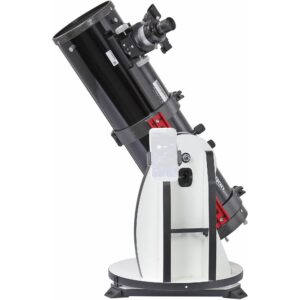
The ideal telescope: A large reflecting telescope on a simple base, also called a dobson mentioned.
2. The digital experience (smart telescopes).
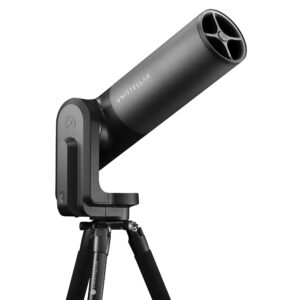
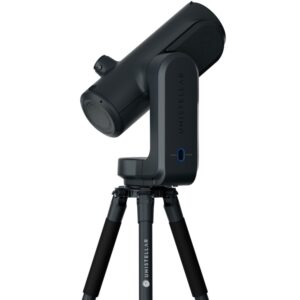
Smart telescopes, such as the seestar s50 Whether the dwarf 3, are the revolution of recent years. They have no eyepiece, but send the image wirelessly to your smartphone or tablet.
The experience: The telescope takes hundreds of pictures in succession and merges them (stacking). As a result, nebulae and galaxies appear on your screen in full color, even from a light-polluted city.
The ideal telescope: An ‘all-in-one’ smart telescope that aligns itself and locates objects automatically.
Optics explained: the holy trinity of specifications
When you have a telescope for beginners comparisons, you always see numbers like 152/1200 or 114/1000. These numbers tell you almost everything about what the telescope can do.
1. Aperture (the opening)
The first value (e.g., 152 mm) is the diameter of the lens or mirror. This is the most important value. A larger aperture captures more light. More light means you can see fainter objects and the resolution (the sharpness of details) is higher.
Golden Rule: For visual observation, choose the largest aperture you can afford and transport. A 150 mm mirror captures more than twice as much light as a 100 mm lens.
2. Focal length (the magnification).
The second value (e.g., 1200 mm) is the focal length. This determines how much the telescope magnifies by itself. A long focal length is ideal for planets because you can more easily achieve high magnifications without having to buy expensive eyepieces.
3. The f-value (luminous intensity)
Dividing the focal length by the aperture gives you the f-value.
F/5 or lower: A ‘fast’ telescope, ideal for wide views of the Milky Way and astrophotography.
F/8 or higher: A ‘slow’ telescope, often better corrected for color errors and perfect for the moon and planets.
Our top recommendations for visual observation
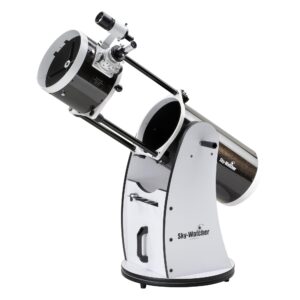
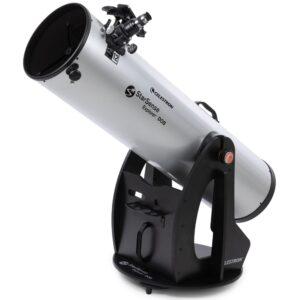
The undisputed number one: An 8-inch Dobson (200mm)
If you ask us what the best telescope for beginners is for visual use, then it is this model. The 200 mm mirror offers unprecedented clarity for this price range. Because it sits on a wooden swivel base (dobson mount), every euro of your budget goes into the quality of the glass and not a wobbly tripod.
What do you see with this? The cassini separation in the rings of saturn, cloud bands on jupiter, the orion nebula with distinct structure and hundreds of craters on the moon.
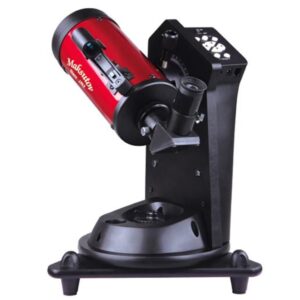
Why the Maksutov telescope is the ‘dark horse’ for beginners
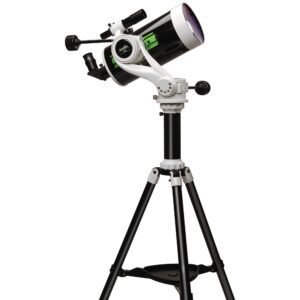
Often only lens or mirror telescopes are discussed, but the maksutov-cassegrain is a great alternative for beginners with limited space.
Compact design: By a clever folding of light, a maksutov with a focal length of 1300 mm is still only 30 cm long.
Planetary sample: Because of the extremely long focal length, they are unmatched for the moon and planets. They give a very contrasty and sharp image.
Maintenance-free: The tube is completely closed. No dust gets in and you never have to adjust (collimate) the mirrors.
Realistic expectations: the truth about color and detail
One of the reasons beginners drop out is that they expect pictures from the hubble telescope. It is important to know what you can and cannot see visually.
No color in mists
Our eye is unable to see color in faint objects in the dark. The orion nebula will be seen by a telescope for beginners appear as a beautiful, green-gray glowing cloud. The color you see in photos is the result of long exposure times to which a camera does have sensitivity.
The power of ‘peripheral vision’
Advanced observers use a technique in which they do not look directly at a dim object, but right next to it. This causes light to fall on the most sensitive parts of your retina. This is a skill you learn as a beginner that takes your observations to the next level.
Magnification: the biggest trap
The box of cheap telescopes often says big “500x magnification!”. Don't fall for this. Every telescope has a maximum useful magnification, which is approximately equal to 2x the aperture in millimeters.
So a 60-mm telescope can magnify up to 120x. If you go above that, the image will only get darker and blurrier. You then only magnify the blur.
For most observations (even planets) a magnification between the 80x and 150x more than sufficient and often even more beautiful because of the stability of the image.
The mount: the foundation of your hobby
You can have the best lens in the world, but you can't see anything on a wobbly tripod. When buying a telescope for beginners you have three main titles:
Alt-Azimut (AZ): Moves up, down, left and right. Very intuitive, like a camera tripod.
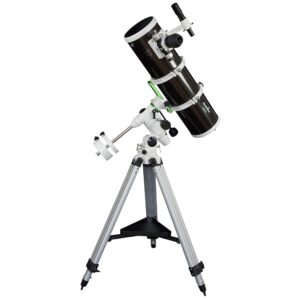
Equatorial (EQ): Must be aligned with the pole star. This allows you to track the earth's rotation by turning only one knob. Essential for photography, but trickier for an absolute beginner.
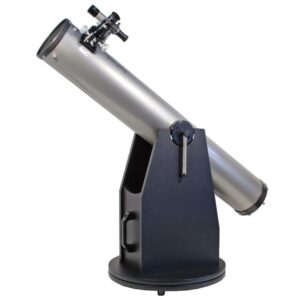
Dobson: A variant of the AZ mount, but on the ground. This is the most stable and cheapest way to carry a large telescope.
The rise of smart telescopes (Smart Telescopes).
In recent years, the seestar s50 the best-selling telescope for beginners. It is a ‘robotic telescope.
Advantages: It looks for everything by itself, takes pictures in color and works perfectly in light-polluted areas. You don't need to know anything about the night sky to still see the most beautiful nebulae.
Disadvantages: You're looking at a screen. For some, this feels less like ‘stargazing’ and more like watching a documentary on a tablet.
Common mistakes made by beginners
Wanting too much magnification: As explained, this leads to a poor picture.
Looking inside through glass: Never look through an open or closed window. The temperature differences and the glass of the window completely distort the image. Always go outside.
Not aligning the viewfinder: The small viewfinder on top of the telescope must be precisely aligned with the main telescope during the day. If this is not correct, you will never find your target at night.
Forgot to cool down: A telescope needs to get used to the outside temperature. Put it outside 30 minutes before viewing to avoid ‘air swirls’ in the tube.
Maintenance and accessories
A telescope for beginners is an investment that will last you for years.
Eyepieces: Start with the two included eyepieces, but know that upgrading to a high-quality eyepiece can improve your image quality directly with 30%.
Cleaning: Never touch the mirrors or lenses with your fingers. Skin grease can corrode the coatings. Use only special cleaning kits for optics.
Collimating: In a reflecting telescope (newton), the mirrors sometimes need to be straightened. This sounds scary, but is squeaky clean with a laser collimator within two minutes.
Why buy from telescoop.co.uk?
We are not do-it-yourselfers. We are passionate astronomers who want you to succeed in this hobby. Any telescope for beginners in our assortment has been selected on the basis of mechanical stability and optical correctness.
Personalized advice: Unsure between a dobson or a starsense? Call us. We look at your living situation (garden or balcony) and your needs.
Prompt delivery: Ordered before 11:59 p.m., delivered within 48 hours.
Aftercare: Need help with your first alignment? Our customer service team is here to help.
Conclusion: your journey through the cosmos begins here
There is no ‘best’ telescope, there is only the best telescope for you.
Want the most impressive visual images and have a garden? Go for the omegon dobson 203/1200.
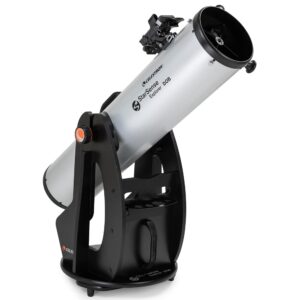
Want help from your smartphone in your search? Choose the celestron starsense explorer.
Want to take instant color photos without technical knowledge? The Seestar s50 is your match.
Do you have limited space or a balcony and want to see planets? Choose a maksutov.
The starry sky awaits you. With the right telescope for beginners the universe is literally at your feet.
 Dutch
Dutch English