
Mounts
Showing 13–24 of 388 resultsSorted by popularity
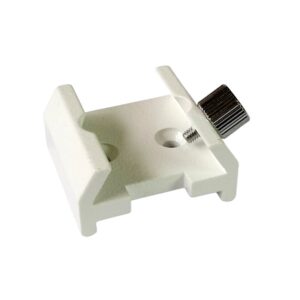
Showing 13–24 of 388 resultsSorted by popularity
Telescope mounts: The indispensable foundation for every stargazer
When people think of astronomy, their attention usually goes immediately to the telescope tube (the OTA). But experienced astronomers know better: the mount is the most important part of your entire setup. Without a stable, accurate mount, even the most expensive telescope in the world is useless. Whether you want to manually track the moon or make hours-long exposures of distant nebulae, the right telescope mount will determine the success of your night under the stars.
In this guide, we dive deep into the world of mounts, from the simple Alt-Azimut to the complex computer-controlled German Equatorial mounts (GEM).
Why the mount is more important than the telescope
The purpose of a mount is twofold. First, it must support the telescope support without vibrations. Once you start magnifying strongly, any small movement (such as the wind or your own touch) is escalated. A wobbly mount makes for a frustrating experience where the image is never stationary.
Second, a mount must have the compensate for the earth's rotation. As the Earth rotates on its axis, stars appear to be constantly moving through the field of view. Without a tracking system, an object at high magnification disappears from view within seconds.
The three pillars of a good mount:
Carrying Capacity (Payload): How much weight can the mount support before the motors burn out or stability is lost?
Stability: How quickly do vibrations dampen out after you touch the telescope?
Accuracy: How precisely can the mount hold an object in the center of the image?
Different types of mounts: Which one do you choose?
There is no “best” mount, there is only the best mount for your specific purpose. We mainly distinguish two flavors: Alt-Azimut and Equatorial.
1. Alt-Azimut (AZ) Mountings.
The Alt-Azimuth mount is the most intuitive choice. It works exactly like a camera tripod: you move the telescope up/down (Altitude) and left/right (Azimuth).
Advantages: Lightweight, quick to set up, no complicated alignment required.
Ideal for: Visual observers, daytime bird watching and quick “grab-and-go” sessions.
Known variant: The Dobson mount. This is a ground-mounted type of AZ mount. It offers the best value for money for those who want to look at planets and deep-sky objects purely visually.
2. Equatorial (EQ) Mounts.
For those serious about astronomy, an equatorial mount is the standard. This is tilted so that one axis is parallel to the earth's axis of rotation (pointed at the Pole Star).
Advantages: You only need to move one axis to track a star. This prevents “image field rotation,” which is essential for astrophotography.
Disadvantages: Heavier, more complex in adjustment (polar alignment) and often more expensive.
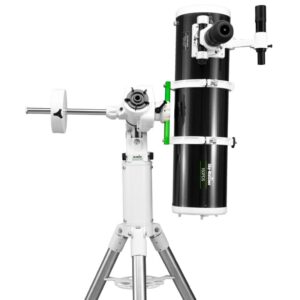
German Equatorial Mount (GEM): The most common form, recognizable by the counterweights that keep the telescope balanced.
GoTo Systems: Navigating at the touch of a button
Today, many mounts are equipped with GoTo technology. This is a built-in computer with a database of tens of thousands of objects. After calibrating the mount, you select, for example, “M42 (Orion Nebula)” on the hand controller or via an app on your smartphone, and the telescope automatically rotates to it.
Is GoTo necessary?
Yes: If you have little time, live in a light-polluted area where you see few reference stars, or if you want to start photographing right away.
No: If you want to learn about the sky through “starhopping” or if you have a limited budget and prefer to invest in larger optics.
Mounts for Astrophotography
Astrophotography places the heaviest demands on a mount. Whereas a visual observer can still forgive a small vibration, a photograph results in blurred stars.
What should a photographic mount meet?
For deep-sky photography (nebulae and galaxies) you need a Equatorial GoTo mount needed. Important terms here are:
Periodic Error: No gear is perfect. Small deviations in movement must be minimal or electronically corrected (PEC).
Autoguiding port (ST-4): This allows you to connect a second, small camera that constantly adjusts the mount based on a tracking star.
Carrying capacity margin: A rule of thumb in astrophotography is: use only 50% to 60% of the specified maximum carrying capacity for photography. If a mount can carry 15kg, it is optimal for a photographic setup of about 8-9kg.
Hybrid and Innovative Technologies
Technology does not stand still. We have seen two major trends in the world of telescope mounts in recent years:
Strain Wave Gear (Harmonic Drive) Mounts
These mounts are a revolution. They use technology from robotics, allowing them to carry extreme weight without the need for counterweights. They are very compact and light, ideal for astronomers traveling to dark places.
Smart Telescopes
Products such as the Seestar or Unistellar combine the mount, telescope and camera in one closed system. Although less flexible, they make the threshold for finding and capturing objects lower than ever.
Maintenance and Accessories for your Mount
A good mount is an investment for life, provided you take good care of it.
Power supply: GoTo mounts eat power. Invest in a good PowerTank or a stable 12V adapter.
Vibration dampers: You place these rubber pads under the legs of the tripod to minimize vibrations from the ground (e.g., a wooden deck).
Balance: Always make sure your telescope is perfectly balanced. This unburdens the motors and makes for much smoother tracking.
Frequently Asked Questions (FAQ)
What mount do I need for a beginner? For a beginner looking to explore the sky, we often recommend a Alt-Azimuth mount or a Dobson to. However, if you want to lay a foundation for photography right away, choose an entry-level EQ mount such as the Sky-Watcher EQ3-2 or the HEQ5.
Can I put any telescope on any mount? Not directly. Most modern telescopes use a Vixen-style or Losmandy-style dovetail. Your mount must have the proper clamp head for these rails. Also, always pay attention to the maximum weight.
What is polar alignment (Polar Alignment)? This is the process by which you precisely align the rotation axis of an equatorial mount with the celestial pole (near the Pole Star). The more accurately this is done, the longer you can expose without the stars becoming streaky.
Conclusion: invest in your foundation
Choosing the right telescope mount is a balance between portability, precision and budget. Remember: a mediocre telescope on a great mount always performs better than a great telescope on a shaky mount.
Whether you choose the simplicity of a manual Dobson or the high-tech precision of a computer-controlled equatorial mount, with us you'll find the stability you need for your next voyage of discovery through the universe.
Want personal advice on which mount suits your telescope and ambitions? Contact our experts!
 Dutch
Dutch English