
Reducers/Flatteners
Showing 13–24 of 42 resultsSorted by popularity
Showing 13–24 of 42 resultsSorted by popularity
Reducers and flatteners: the secrets to a perfect field of view
Anyone who takes the step from visual observation to astrophotography soon discovers that a telescope that produces beautiful images through an eyepiece does not automatically produce perfect photographs. This is because a camera's sensor is mercilessly flat and captures every optical error flawlessly. This is where reducers and flatteners become essential. These optical correctors are the silent forces behind those breathtaking astrophotos with razor-sharp stars from corner to corner and impressive depth.
At telescoop.nl, we consider a good corrector not a luxury, but a necessary part of your setup. Whether you are working with a fast refractor or a powerful schmidt-cassegrain: the right reducer or flattener determines whether your photos end up in the trash or on the wall.
What is a field flattener?
Most telescopes naturally have a curved field of view (field curvature). While your eye corrects this while looking by adjusting focus, a flat camera sensor cannot. The result is frustrating: if the stars are sharp in the center, they turn into hazy specks or blurred discs toward the edges.
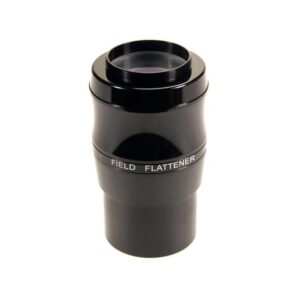
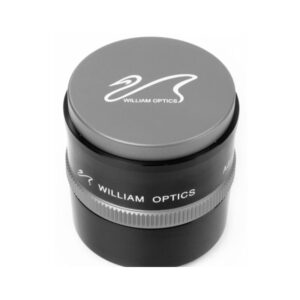
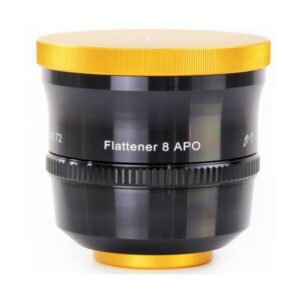
A field flattener is a lens group specifically designed to compensate for this curvature. It flattens the field of view without changing the focal length of your telescope. This is crucial for photographers working with larger sensors (aps-c or full-frame), where errors are most visible at the edges of the field. With a quality field flattener stars remain pointed to the extreme corners, allowing you to utilize the full potential of your camera.
The power of the focal reducer
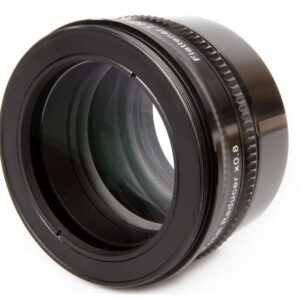
A focal reducer does something else: it shortens the effective focal length of your telescope. A reducer with a factor of 0.8x turns a telescope with 1000 mm focal length into an 800 mm system. This offers two huge advantages for the astrophotographer:
Larger field of view: You literally get more of the sky on your sensor. This is ideal for vast nebulae such as the orion nebula or the andromeda galaxy, which otherwise simply won't fit in their entirety in the photo.
Shorter exposure times: A reducer makes your telescope “faster.” Technically, you lower the f-value. A shorter focal length at the same aperture means more light falls on each pixel. This allows you to collect more data in less time, which is essential during short winter nights or when you want to reduce the load on the mount.
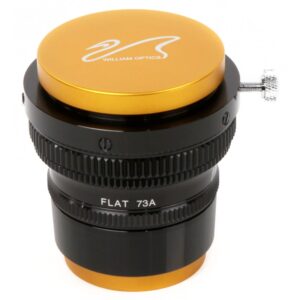
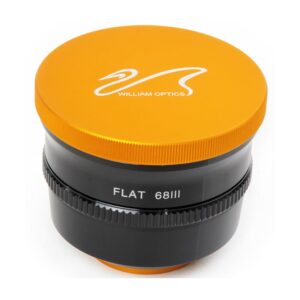
Many modern correctors today are “reducer/flatteners,” meaning they combine both functions in one housing. This saves space on your imaging train and ensures perfect optical alignment.
The holy grail: backfocus and the 55 mm rule
When you start reducers and flatteners, you inevitably come across the term backfocus against. This is the exact distance between the back of the corrector and the sensor of your camera. Unlike eyepieces, these correctors listen extremely closely.
Most flatteners are designed for a back focus of exactly 55 millimeters. If you miss this by more than a millimeter, the corrector loses its effect. You will still see distorted stars in the corners. Achieving this distance often requires a precise combination of adapters and spacers. At telescoop.nl, we are happy to help you calculate this distance so that you don't have to guess and get immediate results.
Which corrector fits your telescope?
Not every reducer or flattener is universal. Optical designs are often specifically tailored to a particular type of optic:
Refractor-correctors: Often designed specifically for a particular brand or model to counteract the specific color errors and field curvature of that lens group.
SCT reducers: The well-known 0.63x reducer for schmidt-cassegrain telescopes is a classic that transforms slow f/10 systems into much faster f/6.3 systems.
Coma correctors: Specifically for newton telescopes to correct the typical “comet-shaped” stars at the edges.
Frequently asked questions about proofreaders
Do I lose image quality by adding an additional lens? At a qualitative reducer or flattener the opposite is true. Although each additional glass element reflects a fraction of light, modern multi-coatings ensure that this loss is negligible. The enormous gain in sharpness across the entire field of view outweighs it many times over.
Can I use a reducer for visual observation? Yes, you can, but it is less common. A reducer can help to get a larger field of view for telescopes with a long focal length, such as a maksutov. Be aware that the mechanical construction is not always easy to combine with any zenith prism.
How do I recognize a wrong backfocus? If the stars in the corners seem to point toward the center of the picture, your camera is probably too close to the flattener. Do the stars appear to rotate in a circle around the center? Then the camera is probably too far away. It's a matter of fine-tuning until the stars are perfectly round in all corners.
Why buy your correctors from telescoop.nl?
Choosing the right reducer or flattener is one of the most technical purchases you can make. The wrong match will lead to vignetting or blur. At telescoop.nl, we have the experience to advise you which corrector will actually work with your particular camera and telescope.
We look beyond the box. We know what threads (m42, m48, m54) you need and how to get that coveted backfocus distance. Order before 11:59 p.m., and you'll have your reducers and flatteners within 48 hours in most cases. Take the frustration out of your astrophotography and choose the security of perfect stars.
 Dutch
Dutch English