
Filters
Showing 1–12 of 161 resultsSorted by popularity
Showing 1–12 of 161 resultsSorted by popularity
Telescope Filters: unlock the true details of the Universe
Anyone looking through a telescope for the first time is often impressed by the moon or a bright planet. But over time, you notice that light pollution, atmospheric glare or simply the brightness of an object can mask details. This is where telescope filters make the difference between “seeing something” and “studying details.”.
A filter is not a luxury accessory; it is an essential tool for increasing image quality, enhancing contrasts and blocking out unwanted light. Whether you're looking at planets from a lit city or want to photograph nebulae deep into the night, the right filter is the key to success.
Why do you need Telescope Filters?
Light is the basis of astronomy, but not all light is desirable. Telescope filters work by allowing specific wavelengths of light through and blocking others. This has three major advantages:
Contrast enhancement: Filters darken the sky background, making faint nebulae or subtle details on planets (such as the Great Red Spot on Jupiter) more visible.
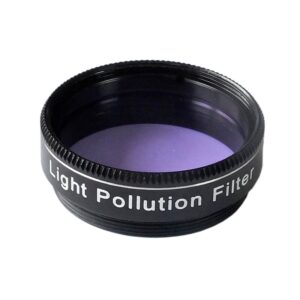
Reduction of light pollution: Special broadband filters filter out the yellowish light from streetlights, keeping deep-sky objects visible even from the city.
Eye protection and comfort: When watching the moon, the brightness can be blinding. A moon filter acts like sunglasses for your telescope, allowing you to observe longer and more comfortably.
The Different Types of Filters
Not every filter is suitable for any object. To make the right choice on our /filters/ page, it is important to understand the main categories.
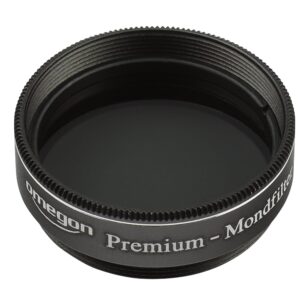
1. Lunar filters (Neutral Density Filters).
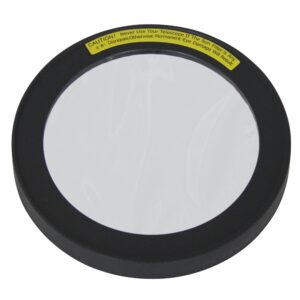
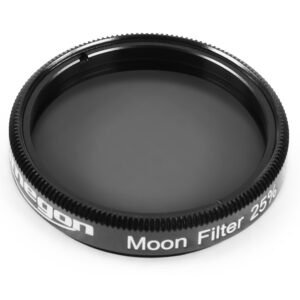
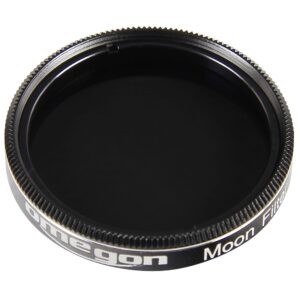
The best-selling filter in the world. The moon reflects an enormous amount of sunlight. Without a filter, your eye gets tired quickly and fine details in the craters are lost due to the excess light.
Variable Polarizing Filter: This is the “high-end” version of a moon filter. By turning the filter, you can infinitely adjust the brightness according to the moon's appearance.
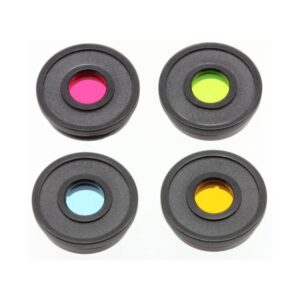
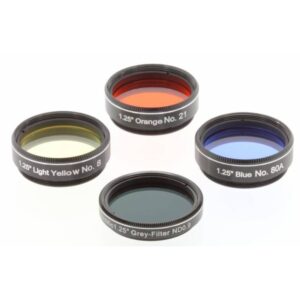
2. Planetary Color Filters
Planets are small and details are often subtle. By using a specific color, you reinforce certain features:
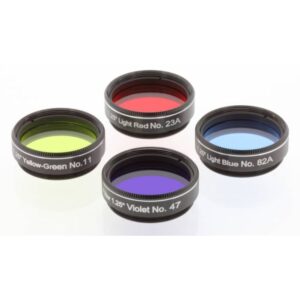
Red/Orange: Enhances details in Jupiter's cloud bands and makes Mars' polar caps visible.
Blue: Increases contrast in Saturn's rings and makes atmospheric phenomena on Venus clearer.
Green: Ideal for observing the ice caps on Mars and the red spot on Jupiter.
3. Deep-Sky Filters (UHC and OIII)
For those looking for nebulae and galaxies, these filters are indispensable.
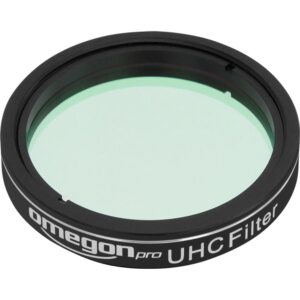
UHC (Ultra High Contrast): An all-round filter that darkens the background, but allows the wavelengths of emission nebulae (such as the Orion Nebula) to pass through.
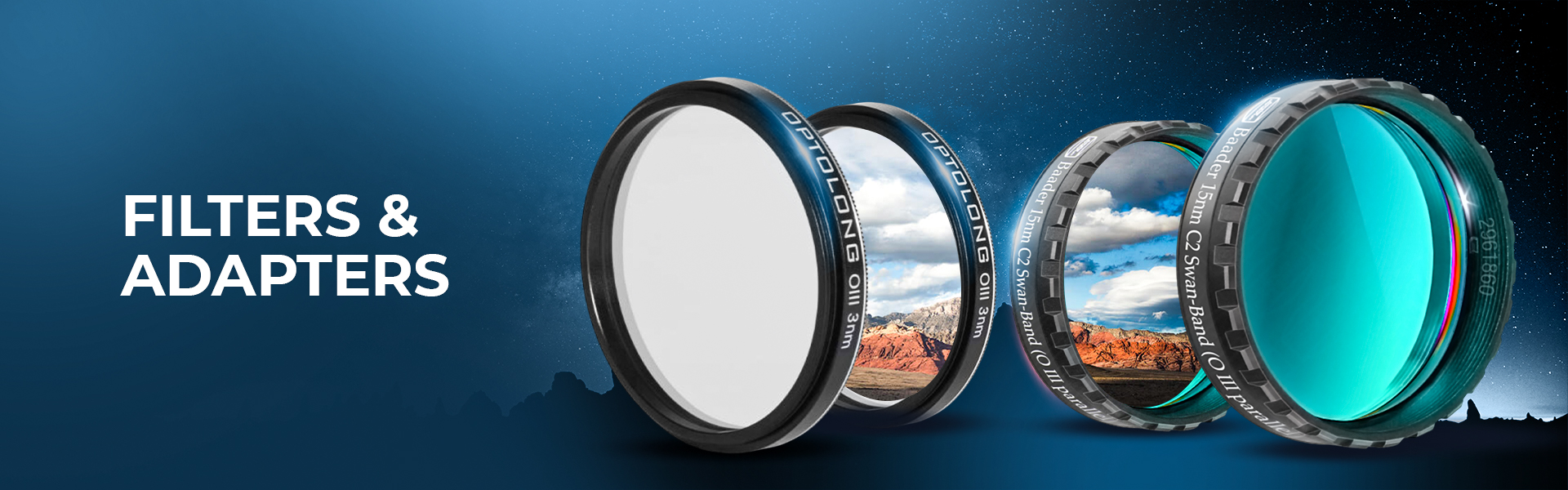
OIII (Oxygen-III): A narrowband filter that is extremely effective on planetary nebulae and supernova remnants. It is like “turning off the light” for everything but the nebula itself.
Filters for Astrophotography
Astrophotography places higher demands on filters than visual observations. Where your eye is forgiving, a camera captures every imperfection.
Light pollution filters (CLS & L-Pro)
If you are shooting from an area with a lot of artificial light, a CLS (City Light Suppression) filter is essential. It blocks the specific wavelengths of mercury and sodium lamps, while preserving the important H-alpha and Oxygen-III lines.
Narrowband Filters (H-Alpha, SII, OIII)
Professional astrophotographers often use monochrome cameras and a set of narrowband filters. These allow you to take pictures in the so-called “Hubble Palette.” Even at a full moon, you can take beautiful pictures with these, because the filter lets only an extremely small fraction of light through.
How do you attach a Telescope Filter?
The use of a filter is extremely simple. Almost all filters on our page are threaded.
1.25-inch filters: You screw this directly into the bottom of your standard eyepiece.
2-inch filters: These are used with larger eyepieces or directly in a camera adapter.
Clip-in filters: Specifically for astrophotographers with an SLR (DSLR) camera; these are placed inside the camera body, in front of the sensor.
Rules of thumb when purchasing a Filter
Before making a choice on our /filters/ page, these rules of thumb will help you get started:
Telescope opening: A heavy OIII filter works best for telescopes with apertures of 150mm or more. For smaller telescopes, a UHC filter is often a better choice.
Visual vs. Photographic: Some filters are specifically designed for cameras and allow light through that the human eye cannot see (such as IR/UV cut). Pay close attention to the product description.
Quality of glass: A cheap filter may distort the image or cause reflections. We select only brands that use optical flat glass and high-quality coatings.
Glossary: Important terms in Filters
Bandwidth: The amount of light (in nanometers) that passes through the filter. The narrower the bandwidth, the stronger the contrast, but the darker the image.
Transmission: The percentage of light that actually passes through the filter. A good filter has a transmission of 90% or higher for the desired wavelengths.
Substrate: The material the filter is made of (usually glass or crystal).
Light Pollution: The collective term for unwanted artificial light that we try to block with filters.
Why buy Telescope Filters from us?
We understand that the world of filters can be complex. That's why we offer not only a wide range of products, but also the assurance of a specialist. Whether you are looking for your first moon filter or a complex set for narrowband photography, we are ready with advice.
Our benefits at a glance:
Expert FAQ: Each filter category contains information to help you make the right choice.
Prompt delivery: Ordered before 11:59 p.m., delivered within 48 hours. So you never miss that one clear night.
Quality assurance: All of our filters are tested for optical performance.
Conclusion: get more out of your Telescope
Without the right filter you often see only half of what your telescope can actually perform. By darkening the background and bringing out details, you transform a dull image into a breathtaking spectacle. Check out our full range on the /filters/ page and find out what you've missed so far.
Need help choosing between a UHC or an OIII filter for your specific telescope? Contact our experts directly or watch the product videos on the page!
 Dutch
Dutch English