
Dobson telescopes
Showing 61–61 of 61 resultsSorted by popularity
Showing 61–61 of 61 resultsSorted by popularity
Buying a Dobson telescope
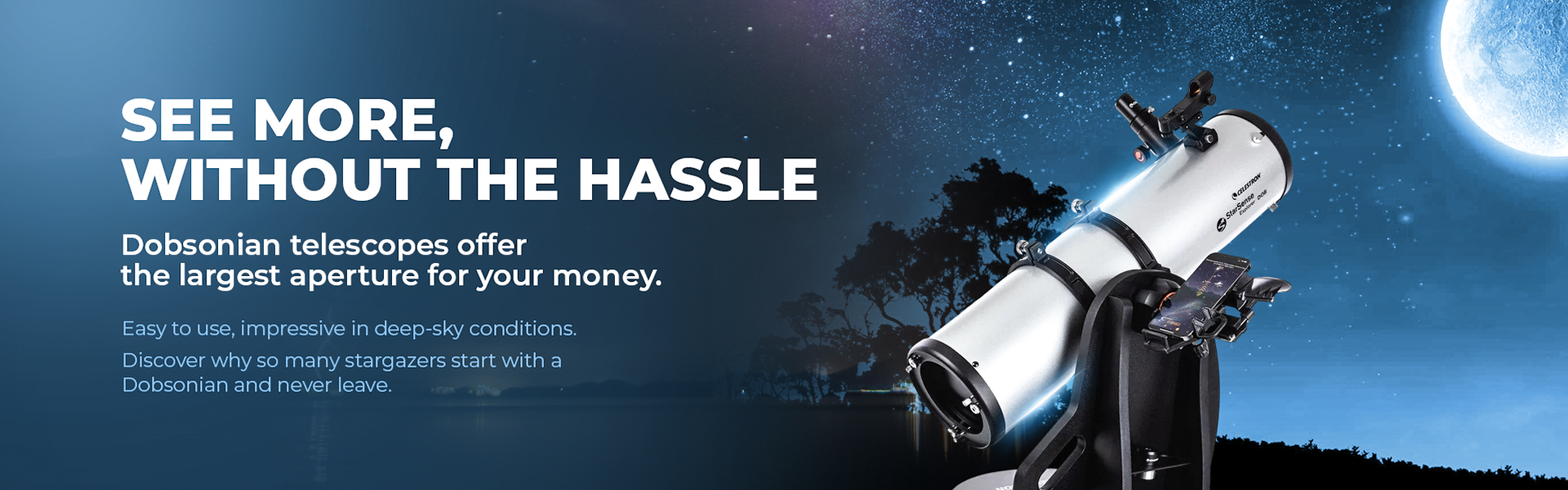
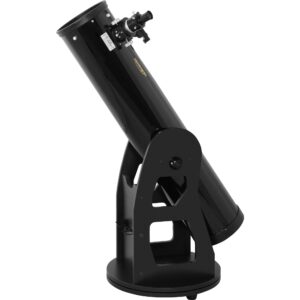
A Dobson telescope is fundamentally the most efficient way to collect a large amount of light for a relatively low investment. Coined by John Dobson in the 1970s, the concept rests on one key principle: combine a powerful optical tube with an extremely simple, wooden mount. Whereas many other telescopes rest on a tripod that can be prone to vibration, a Dobson rests on a so-called ‘rocker box. This is a sturdy platform that is placed directly on the ground, providing significantly higher stability during viewing than many entry-level telescopes with a flimsy aluminum tripod.
The optical operation of this type is that of a Newton reflector. At the back of the tube is a parabolic primary mirror that collects and concentrates the incoming light. Through a small, angled secondary mirror at the top of the tube, the image is reflected to the side, where the view (the eyepiece) is located. Because with a Dobson you are looking at the side of the top, the viewing position often remains comfortable even when the telescope is pointing straight up toward the zenith. The movement is entirely manual and is via Teflon or roller bearings, which ensures smooth rotation about the horizontal axis (azimuth) and the vertical axis (elevation).
Why choose a Dobson telescope?
The popularity of the Dobson telescope among both beginners and advanced amateurs comes from the relationship between mirror diameter and price. With a telescope, the aperture (aperture) is the most important factor; the larger the mirror, the more light is captured and the fainter objects become visible. Because the mount of a Dobson is cheap to manufacture from wood and simple bearings, most of the budget goes to the optics. As a result, with a Dobson you can often purchase a 200 mm or 254 mm mirror for the same amount of money for which you get only a 100 mm or 120 mm objective with other systems.
Another big advantage is the speed of set-up. No counterweights need to be balanced and no power supply is required for the basic models. You set up the rocker box, insert the tube, and you can start observing immediately. This makes the barrier to lifting the telescope out for a short session a lot lower than with more complex systems. Moreover, operation is very intuitive: you simply push the tube in the direction of the object you want to see.
The reality of observing with a large mirror
Although a Dobson telescope often praised for its ability to show distant galaxies and nebulae, it is important to have realistic expectations. In astronomy, we often talk about ‘aperture fever,’ the urge to get a bigger and bigger telescope. A 300-mm mirror captures an impressive amount of light, but the tube is long and the base heavy. If a telescope is too big or heavy to move on its own, it will more often than not stay indoors.
What do you really see through a Dobson?
Deep-sky objects: In a 200 mm model, galaxies appear as gray, diffuse spots. You don't see colors like in photographs of the NASA, because the human eye cannot register color in low light. However, you can distinguish the spiral structure in the Andromeda Galaxy or the details in the Orion Nebula in good conditions.
Planets and the Moon: Because of the often long focal length, Dobsons are excellent for high magnifications. The craters on the Moon show enormous shadow detail, the rings of Saturn can be seen separate from the planet, and on Jupiter the cloud bands and the Great Red Spot are visible.
Light pollution: A large mirror only really performs well under dark skies. In a city with many lampposts, a large Dobson will also catch a lot of ‘false’ light, reducing contrast in nebulae.
Different versions of the design
Not every Dobson telescope is a solid, dense tube. Several variants have been developed to meet the desire for portability:
Full Tube (Full Tube): The most robust variant. The tube protects the mirrors well from dust and stray light from the side. The disadvantage is that models from 250 mm and up often do not fit in the back seat of an average car.
Truss-tube or Collapsible: Here, the connection between the bottom (with the main mirror) and the top (with the catch mirror and eyepiece) consists of extendable rods or separate tubes. This makes a 300 mm or even 400 mm telescope compact enough for transport. These models do need to be collimated (optically aligned) more often because the structure may move slightly during transport.
Table Dobsons: Small versions with a mirror from 76 mm to 150 mm. These are light and compact, but require a sturdy elevation or table for comfortable viewing.
Navigation and technology: Push-To and GoTo
A common point made at the Dobson telescope is that manually searching for objects can be difficult. Moreover, because the earth rotates, objects slowly drift out of the visual field, especially at high magnifications. To solve this, more modern systems are available that combine classic simplicity with digital assistance.
At a Push-To system, there are sensors (encoders) mounted on the axes. Through an app or a handheld controller, you can see exactly where the telescope is pointing. You still push the telescope yourself, but the technology tells you when you're aiming ‘tangentially. This retains the silence and speed of a manual telescope, but removes the frustration of searching.
A GoTo Dobson is equipped with motors. The telescope locates the object completely independently and, more importantly, continues to track the object. This is ideal for those who want to peer at one detail on a planet for an extended period of time without having to correct the tube every 30 seconds. However, keep in mind that these systems require a battery or power point and make the telescope heavier due to the addition of motors and gears.
The limitations of astrophotography
It is a common misconception that with a Dobson telescope easily take professional photos of galaxies. Although the optics are fantastic, the mount does not lend itself to this. Deep-sky photography requires exposure times of minutes. Because a Dobson moves on an azimuthal axis (left/right and high/low), ‘image field rotation’ occurs. Moreover, the manual version is not accurate enough to compensate for the earth's rotation for photography.
What can be done: ‘lucky imaging’ of the Moon and planets. With a smartphone adapter or a special planetary camera, you can take short video recordings of the Moon or Jupiter. By stacking the best frames from this video, you can get very sharp results. However, the beautiful, colorful photos of nebulae require an equatorial mount, where the telescope rotates with the earth's axis.
Maintenance and collimation
Those who have a Dobson telescope owns, should be prepared to do occasional maintenance. Because the tube is open at the top, dust can get on the mirror. By the way, this is not as bad as it seems; a little dust hardly affects image quality. More important is collimation. Because the mirrors rest in cells, they may shift slightly due to vibration during transport. Aligning these mirrors is a skill that every Dobson owner must master. Using a laser collimator, this is usually done within minutes, but it is a necessary operation to get the maximum sharpness out of the telescope.
Making the right choice at Telescoop.nl
Choosing the right Dobson telescope is a balance between optical power and practical handling. A 200 mm (8 inch) model is often seen as the gold standard for beginners: large enough to see structure in distant nebulae, but still compact enough to lift out in one trip.
If you find that you are primarily interested in visually experiencing the grandeur of the universe and have no immediate ambition to practice complex astrophotography, then the Dobson offers the most value for money. It is an instrument that forces you to learn about the sky, but rewards you for doing so with images that a smaller telescope simply cannot produce.
Still have questions about what size mirror is manageable in your situation, or want to understand the difference between a manual model and a GoTo system in practice? If so, contact us for specific advice that suits your observation location and physical capabilities.
 Dutch
Dutch English