
Tripods
Showing 13–24 of 48 resultsSorted by popularity
Showing 13–24 of 48 resultsSorted by popularity
Tripods for telescopes: the rock-solid foundation of any observation
First-time buyers of a telescope or large binoculars often focus immediately on magnification and lens quality. But in practice, you soon find out that your optics are only as good as the surface on which they stand. A tripod in astronomy is much more than a simple undercarriage; it is the foundation that absorbs vibrations and causes your image to stand still. Nothing takes you out of the wonder of the universe faster than a vibrating image where every breath of wind causes the moon to dance out of your eyepiece. At telescoop.nl, we see a solid tripod therefore as an investment in viewing pleasure and peace of mind.
The importance of a qualitative tripod becomes really clear only at high magnifications. This is because when you look at a distant planet, you are magnifying not only the object, but also every minute movement of your mount. A base that is too light or made of materials that transmit vibrations makes it impossible to see finer details. A well-chosen base allows vibrations to dissipate within a fraction of a second, allowing your eye to relax and actually observe those subtle cloud bands on jupiter or the gossamer structures in a nebula.
The choice of materials: steel, aluminum or carbon?
The search for the right tripod usually begins with the choice of materials. Each material has its own character and behavior under the stars.
Aluminum Tripods
Aluminum is the most common choice. It is relatively light, affordable and resistant to the elements. For most beginning astronomers, an aluminum tripod a fine balance between portability and sturdiness. The downside, however, is that aluminum can hold vibrations for quite a long time. If you tap the telescope, it takes a while before the image is completely still again.
Steel tripods
For the serious astrophotographer or the possessor of a heavy catadioptric telescope, such as a large schmidt-cassegrain, stainless steel is the standard. Steel tripod legs are heavy and massive. That extra weight is a great advantage in this case: it lowers the center of gravity of the entire setup and provides unprecedented stability. Steel is therefore especially popular for setups that remain in the backyard or are placed in a permanent observatory.
Carbon fiber tripods (carbon fiber)
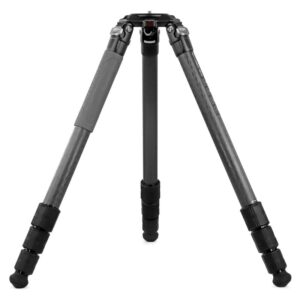
Carbon is a special material because it is extremely stiff, but at the same time very light. What really sets carbon apart from metal is its ability to absorb vibrations almost instantly. It naturally dampens movement. For the traveling astronomer who travels by plane or takes long walks to a dark place, a carbon tripod the ultimate choice.
Carrying capacity and the safety factor
A common mistake when purchasing a tripod is to ignore the margins in carrying capacity. In photography a limit is often leading, but in astronomy we work with extreme magnifications.
A good rule of thumb is to use a tripod choose one that can support at least one and a half times the weight of your telescope, mount and accessories. Do you have an eight-pound setup? Then look for a model that can handle at least twelve to fifteen pounds. This excess capacity keeps the system from operating at the limit of its ability, maintaining rigidity and eliminating vibrations faster. Nothing is more unnerving than an undercarriage that bends noticeably under the weight of your precious optics.
Mechanics: legs, spreaders and center columns
Look at a tripod also to the way the legs are locked. You usually have a choice between clamp locks and twist locks. Clamp locks work quickly, which is ideal when setting up in the dark. Rotary latches are often considered more robust and have no protruding parts that you can get caught behind with a cable.
Another important component is the accessory platform (the spreader) that is stretched between the legs. This platform serves not only to put your eyepieces down on, but it also has a structural function: it pushes the legs out and pulls the whole structure taut. A tripod without such a spreader is often considerably less stable.
Leveling: the basis for good tracking
Especially for those using an equatorial mount or go-to system, it is essential that the tripod is exactly level. If the base is skewed, the computer's calculation is no longer correct and your telescope will not be able to find or track objects properly. Most modern tripods Have a built-in level (vial).
On soft ground, such as grass, it is wise to press the legs down well so that they do not slowly sink during the night. There are special ‘vibration suppression pads’ available that you can place under the legs to further dampen vibrations and prevent sinking.
Frequently asked questions about tripods
Can I use my camera tripod for my telescope? For a very small travel refractor or binoculars, this can be done, but most photographic tripods are not designed for the extreme magnifications of a telescope. They often lack the rigidity needed to dampen vibrations quickly.
How do I prevent rust on my steel tripod? After a damp night, it is important to wipe the legs with a dry cloth before sliding them in and storing them. A small drop of silicone spray on the moving parts can help, but be sparing with this so as not to attract dust and sand.
Is a heavier tripod always better? For stability, yes, but for portability, no. Best tripod is the tripod you actually take outside. Carbon often offers the best solution here: the stability of steel with the weight of aluminum.
Your foundation at telescoop.nl
At telescoop.nl, we understand that a tripod may not be the most exciting part of your gear, but we also know that it can make or break your fun. That's why we've put together a selection of tripods that have made their mark in the field. From lightweight travel tripods for your binoculars to leaden steel pillars for your astrophotography setup, we have the right base for every scope.
If you order today before 11:59 p.m., we'll make sure you get tripod delivered in most cases within 48 hours. So you can immediately enjoy a rock-solid image on the next clear night and view the night sky as it was intended: razor-sharp and undisturbed.
 Dutch
Dutch English