
Polar Wedges
Showing 13–13 of 13 resultsSorted by popularity
Showing 13–13 of 13 resultsSorted by popularity
Polar Wedges: The Transition to Equatorial Precision
A Polar Wedge It's the missing puzzle piece for anyone transitioning from simple night photography to long deep-sky exposures. Where a standard tripod is limited to horizontal and vertical movements (alt-azimuth), a polar wedge allows you to align the rotation axis of your mount precisely parallel to the Earth's axis. At Telescoop.nl, we consider the polar wedge to be the most critical component of a mobile setup: without this mechanical tilt, tracking stars without field rotation is simply impossible.
Whether you're working with an ultra-compact tracker like the Omegon MiniTrack or an advanced system like the Sky-Watcher Star Adventurer, the stability of your wedge determines the maximum exposure time of your shots.
Why a specific Polar Wedge necessary
Many beginners try to tilt their camera tracker on a standard tripod head. This inevitably leads to sagging and vibrations. A professional wedge, such as that from William Optics or iOptron, offers specific mechanical advantages:
Fine-tuning the North Star: A good wedge features precision screws for both latitude (altitude) and azimuth (left/right). These allow you to make micro-adjustments that are impossible with a standard equatorial mount, which is essential for flawless polar alignment.
Load Capacity and Stiffness The wedges from brands like Sky-Watcher and William Optics are designed to bear the weight of both the mount and the camera and lens without the set angle drifting. This prevents your composition from slowly sinking throughout the night.
Geometric stability: At Telescoop.nl, we select wedges manufactured from CNC-machined aluminum. This material guarantees that the set latitude—crucial for your specific location—remains rock-solid, even with temperature fluctuations.
Integration within the mobile ecosystem
You will find this specialized hardware under telescope-accessories/mounts/mount-accessories/polar-wedges/.
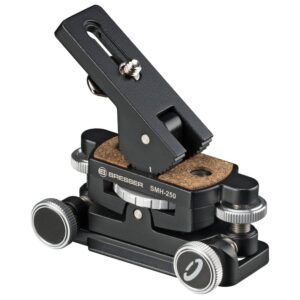
Within our range of mount accessories forms the polar cradle, the mechanical interface between your tripod and your mount. We have built our range so that there is a suitable solution for every system, whether you are looking for a separate wedge such as the Bresser MH-100 or a complete set including mounting iOptron. At Telescoop.nl, we understand that the synergy between your tripod and the wedge eliminates the weakest link in your imaging train.
Technical aspects of the pole cradle
When choosing a polar wedge, there are three parameters that influence the quality of your data:
Latitude Range: Not every wedge is suitable for every location on Earth. We carry specific models of William Optics for both high and low latitudes. Always check that the wedge can easily handle the angle of your observation location (in the Benelux, approximately 51°-53°).
Mounting bracket: Most modern wedges use a 3/8″ thread for tripod attachment and a Vixen-style clamp for mounting. Our models of Sky-Watcher and iOptron are universally interchangeable within these standards.
Mechanical Backlash In the fine-tuning of a wedge, there should be no play. Our premium selection guarantees that every turn of the knob results in a direct, smooth movement of the pole axis, preventing frustration during alignment.
Expertise for the traveling astronomer
Are you going on an expedition to a dark location and need your setup to be lightweight but unshakeable? The choice between a compact Bresser wedge of a high-end William Optics model depends on your total payload and your ambitions. At Telescoop.nl, we have the practical experience to advise you on the ideal balance between portability and precision. We ensure your mount is precisely aligned with the pole, so you can focus on collecting photons.
 Dutch
Dutch English