
Imaging Filters
Showing 13–24 of 61 resultsSorted by popularity
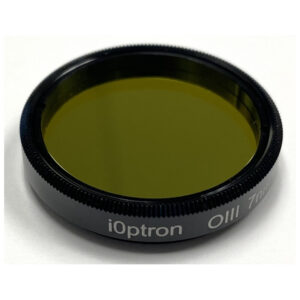
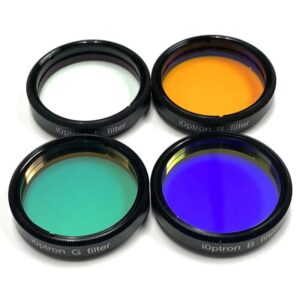
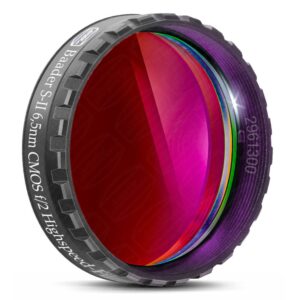
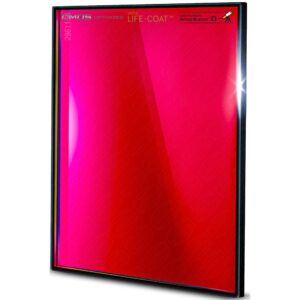
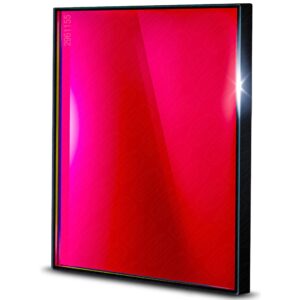
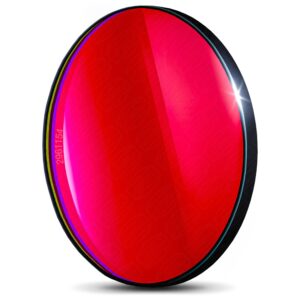
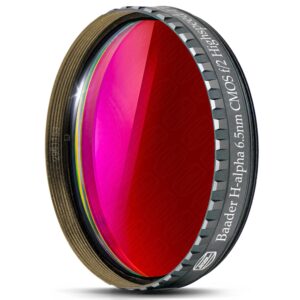
Showing 13–24 of 61 resultsSorted by popularity
Imaging filters: Narrowband and LRGB for professional astrophotography
Anyone who takes the step towards serious deep-sky photography with a mono camera will inevitably end up with imaging filters. Where a color camera is limited by its fixed Bayer matrix, a system with separate filters from top brands like Bresser, Explore Scientific and Omegon The ultimate control over contrast and color balance. By splitting light into specific channels, you not only bypass the effects of light pollution but also capture details that remain hidden to the human eye.
At Telescoop.nl, we exclusively select interference filters with extremely high transmission and a minimal bandwidth (FWHM), so that every photon your telescope captures actually reaches your sensor.
LRGB vs. Narrowband: The Two Paths to Perfection
Depending on your subject and your location, you choose a specific filter set:
LRGB Filters (Luminance, Red, Green, Blue): The basis for true-color recordings of galaxies and star clusters. A qualitative LRGB set of Omegon or Explore Scientific is designed for parfocal, meaning you don't have to refocus when you switch color channels.
Narrowband Filters (H-alpha, OIII, SII): The holy grail of nebula photography, also known as the ‘Hubble Palette’. By only letting through the emission lines of hydrogen (Ha), oxygen (OIII), and sulfur (Sii), you can photograph even from a light-polluted backyard with the contrast of a desert location.
H-alpha (Hα): With a bandwidth of only a few nanometers (nm), the filters of Bresser the finest structures in emission nebulae, insensitive to the moon phase or streetlights.
Optical integration in your imaging train
You will find these specialized instruments under telescope-accessories/imaging-filters-narrowband-and-lrgb/.
Within our telescope accessories These filters form the most technically advanced product group. They are the necessary extension to your eyepieces and barlows when you switch to digital logging. At Telescoop.nl, we understand that a mono workflow demands precision. Our deep categorization ensures the astrophotographer can immediately find the parfocal sets needed for an efficient night under the stars.
What should you pay attention to with imaging filters?
In narrowband and LRGB photography, the quality of the filter determines the final signal-to-noise ratio of your stack:
Bandwidth (FWHM): The smaller the bandwidth (e.g., 7nm or 3nm), the less stray light there is and the more contrast. Our filters of Explore Scientific and Omegon are optimized for maximum suppression of unwanted wavelengths.
Halo reduction Cheaper filters often cause reflections (halos) around bright stars. The high-quality coatings on the filters of Bresser and our other top brands minimize this effect, even with long exposure times.
Substrate thickness: For filter wheels, it is crucial that all filters in the set have exactly the same thickness. All our sets are selected for mechanical consistency, so your focus point remains stable.
Expert Advice: Build Your Own Filter Train
Do you have a CMOS camera with a small pixel size and want to know if a 3nm or 7nm H-alpha filter will give you the best results for your optics? Or are you looking for a specific 1.25-inch LRGB set? Omegon To take your first steps in mono-photography? At Telescoop.nl, we have the data and practical experience to guide you in setting up your filter wheel. We ensure your hardware doesn't become a bottleneck for your data.
 Dutch
Dutch English