
Focus & Navigation
Showing 1–12 of 16 resultsSorted by popularity
Showing 1–12 of 16 resultsSorted by popularity
Focusers: the key to a razor-sharp image
When you look through the eyepiece of a telescope, there is one action you do more often than anything else: focus. Whether you're looking at the cratered edges of the moon or trying to capture the gossamer structures of a distant nebula, everything hinges on the quality of your focuser. This mechanical component has the arduous task of moving your eyepiece or camera with a precision of fractions of a millimeter, without shifting or vibrating the image.
At telescoop.nl, we know that the standard focuser on many entry-level telescopes is often the weakest link. An upgrade to a quality focuser is therefore one of the most effective improvements you can do to your telescope. It changes the experience from “almost sharp” to “perfectly defined.”.
Why a good focuser makes all the difference
An inferior focuser often suffers from ‘image shift’ or ‘backlash. With image shift, the object in your image field shifts as soon as you turn the focus knob, because the internal tube has play. With backlash, you turn the knob, but nothing happens for the first millimeter. This makes focusing at high magnifications a nerve-racking process.
A high-quality focuser from our range eliminates these problems. Through the use of precision bearings and superior mechanical designs, the optical axis remains precisely centered and the telescope responds immediately to any minimal adjustment.
The different types: Crayford vs. Rack-and-Pinion
Within the category focusers we distinguish between two popular designs:
1. Crayford focusers
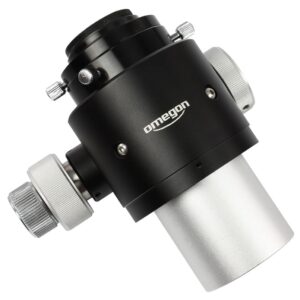
The Crayford focuser is popular with visual observers and photographers alike. Instead of teeth interlocking, this system works on the basis of friction (friction) via roller bearings.
Advantage: It offers unprecedented smooth movement without any backlash.
Application: Ideal for refractors and Newton telescopes where speed and agility are more important than carrying extremely heavy camera equipment.
2. Modern Rack-and-Pinion (rack-and-pinion).
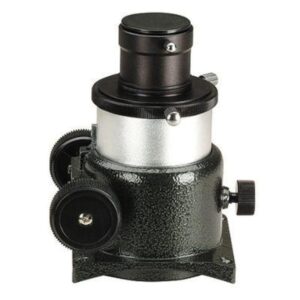
Whereas the old rack and pinion focusers were often rigid, the modern versions we offer are masterpieces of engineering. They use helical gears for very direct and powerful transmission.
Advantage: These focusers can carry a much higher weight without slipping.
Application: The standard choice for astrophotographers working with heavy filter wheels and cooled cameras.
The revolution of the Dual-Speed (1:10) delay
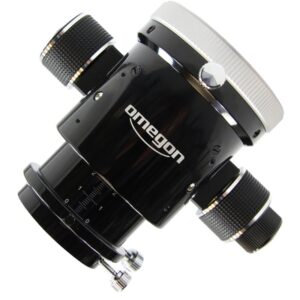
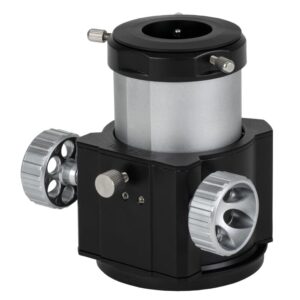
If you are serious about astronomy, a focuser with a 1:10 delay an absolute necessity. This system has two knobs: one for coarse focusing and a smaller knob that turns ten times slower.
Fine adjustment allows you to literally ’tune’ the focus. This is especially crucial in planetary observation and astrophotography, where the focus ‘sweet spot’ is sometimes only a few micrometers in size. A dual-speed upgrade keeps you from accidentally turning past the sharpest point.
Carrying capacity and stability
When choosing a new focuser it is important to consider the weight of your accessories. A heavy 2-inch diagonal with a heavy wide-angle eyepiece can cause a simple focuser to deflect (flex). This causes blur on one side of the field of view. Our high-end focusers are designed to carry pounds of equipment while keeping the alignment dead straight.
Frequently asked questions about focusers
Will any focuser fit my telescope? No, focusers are often designed for specific tube diameters or telescope types (for example, for a Schmidt-Cassegrain back or a Newton tube). Always check the flange diameter or contact us for advice on the correct adapter.
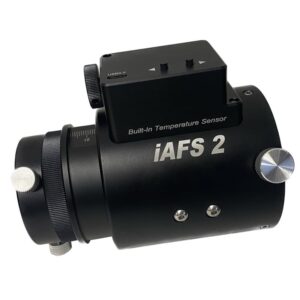
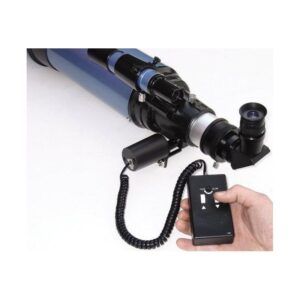
What is a motorized focuser? For the ultimate in precision (and to avoid vibrations from touch), you can put a focus motor on your focuser mount. This allows you to focus via a hand controller or computer, which is essential for automatic astrophotography sessions.
How do I maintain my focuser? Always keep the rails of a Crayford focuser grease-free; it operates on friction. On a Rack-and-Pinion system, a small amount of acid-free machine oil on the teeth can help keep the movement smooth. Above all, prevent sand or dust from getting into the mechanism.
Upgrade your viewing experience at telescoop.nl
At telescoop.nl, we believe that mechanical quality is just as important as optical quality. A telescope that does not focus pleasantly will ultimately not be used. By investing in a superior focuser, invest in the peace and accuracy of your hobby.
Our selection includes only focusers that we have tested ourselves for durability and precision. Need help determining the right adapters for your specific telescope tube? Our specialists are ready to help you. If you order before 11:59 p.m., you'll have your upgrade in most cases within 48 hours. Take the frustration out of your focusing and experience the sky razor sharp.
 Dutch
Dutch English