
Eyepiece sets
Showing 13–13 of 13 resultsSorted by popularity
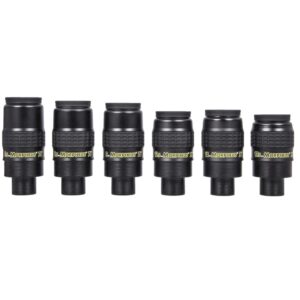
Showing 13–13 of 13 resultsSorted by popularity
Eyepiece sets: The complete basis for any observation
A telescope is only as good as the eyepiece you put in it. Many beginners make the mistake of buying separate, cheap eyepieces that don't match. With our eyepiece sets you solve that problem all at once. You get a carefully curated range of focal lengths, giving you the right magnification instantly at hand for every object - from wide-field nebulae to the smallest details on the Moon.
At Telescoop.nl, we choose sets that add real value. No padding accessories, but quality glass in a sturdy case.
Why choose a set rather than separate eyepieces?
The biggest advantage of a set is the grad. A good set is built so that the steps in magnification are logical. You don't have to guess whether your next step is too big or too small; the manufacturer has already done the math for you.
Consistency: In a set, the eyepieces often have the same build quality and ‘eye-relief’ (viewing distance). This looks a lot calmer to your eyes.
Protection: Most sets come in a padded case. This keeps your optics dust-free and safe during transport to a dark observing location.
Price advantage: A complete set is almost always more economical than buying each eyepiece, filter and the case separately.
A logical structure for maximum results
You will find these sets here. This is no accident. An eyepiece set is the fundamental extension of your basic equipment. Because of this deep categorization, seasoned astronomers and search engines alike understand that this is where specialty bundles come together. We lead you straight to the core: complete optical solutions with no detours.
What should you look for in an eyepiece set?
Not every suitcase is gold that shines. When making your choice, consider the following points:
Plössl or Widefield: Entry-level sets often consist of good Plössl eyepieces. Fine for planets. Want to do deep space (DSO) viewing? Then look for sets with a larger apparent field of view (e.g., 68 degrees or more).
Filter integration: Many sets include moon or color filters. These are useful extras, but the quality of the glass in the eyepieces should always be the deciding factor.
The ‘Hole’ in your magnification: Check that the set matches the focal length of your telescope. A set with a 4mm eyepiece is great for a fast reflector, but on a long refractor telescope this can often be too much of a good thing (blurred image).
Advice from the specialist
An eyepiece set is an investment for years. Don't buy the first best plastic case, but look at the coating and build quality. Unsure if a specific set fits the aperture ratio of your scope? We've tested them all under the stars. Just ask us and we'll make sure you're not stuck with unnecessary magnifications.
 Dutch
Dutch English