
Diagonals
Showing 25–36 of 46 resultsSorted by popularity
Showing 25–36 of 46 resultsSorted by popularity
Diagonals and prisms: the backbone of visual viewing comfort
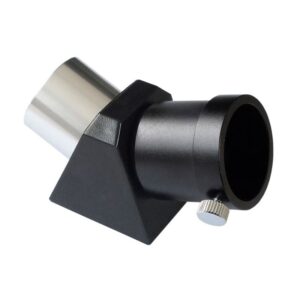
Anyone who has ever tried to look straight up to the zenith with a lens telescope without aids knows how painful it can be for the neck and back. A diagonal (also called zenith mirror or prism) is therefore an indispensable accessory for virtually any refractor, Schmidt-Cassegrain or Maksutov telescope. It deflects light by 90 degrees, allowing you to comfortably look into the eyepiece from above, no matter how high your telescope is aimed.
In telescoop.nl, we consider the diagonal as much more than just a bend in the light path. It is an optical component that directly affects the contrast, brightness and color fidelity of your image. In this guide, we explain why upgrading your standard diagonal is one of the most noticeable improvements to your telescope.
The two main flavors: Prism vs. Mirror
When you have a diagonal you are faced with a choice between a prism and a mirror. Although they serve the same purpose, they work optically differently.
1. Zenith prisms
A prism uses a solid block of glass to deflect light via total internal reflection.
Advantages: Prisms are durable and do not have a reflective coating that can oxidize over time. In telescopes with long focal lengths (such as Maksutovs), they can even slightly improve contrast.
Amici prism: This is a specific type of prism that not only straightens the image, but also corrects it from left to right. This is ideal for daytime observations (bird watching, landscapes), but less suitable for astronomy because of the ‘diffraction line’ that sometimes runs through bright stars.
2. Zenith mirrors
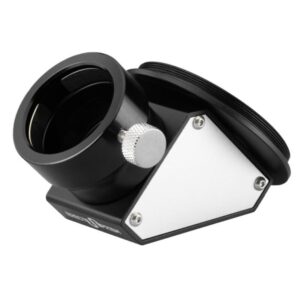
Most modern astronomers prefer a mirror. In this, light bounces off an extremely flat ground mirror surface.
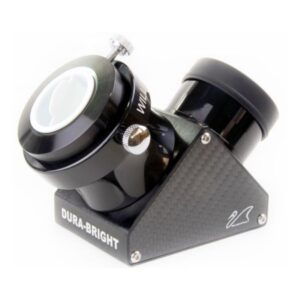
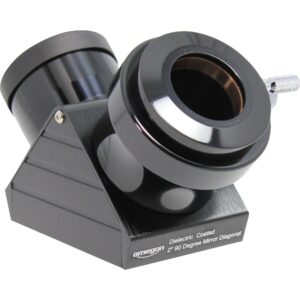
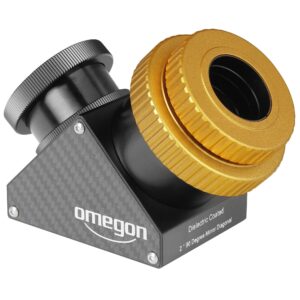
Dielectric mirrors: This is the gold standard. Whereas standard mirrors reflect only 85-90% of light, dielectric mirrors achieve a reflectivity of 99%. This means a visibly brighter image and more contrast in faint deep-sky objects.
Why the quality of your diagonal is crucial
Many telescopes come standard with a simple prism. While this is functional, it often forms a ‘bottle neck’ for the rest of the optics. An inferior diagonal can cause the following problems:
Light loss: In cheap mirrors, as much as 15% of the collected light is lost.
Spherical aberration: If the mirror or prism is not perfectly flat, you will never really get the image razor sharp.
Astigmatism: A poorly mounted live optical element can distort stars into tiny dashes.
An upgrade to a high-quality 2-inch dielectric diagonal ensures that all the light your telescope collects actually reaches your eye, preserving all the details.
Mechanical construction: clamps and threads
In addition to the optics, the mechanical construction of a diagonal of great importance. Nothing is more annoying than an eyepiece that wobbles or, worse, gets scratched by a clamping screw.
Compression Rings: Our better diagonals feature a brass clamping ring. This distributes pressure evenly across the eyepiece, making it more secure and preventing scratches on the sleeve of your precious eyepieces.
Filter thread: Almost all 2-inch diagonals have a thread on the telescope side for filters. This allows you to leave one 2-inch moon filter or UHC filter in the diagonal, for example, while changing different eyepieces.
Frequently asked questions about diagonals
Will a 2-inch diagonal fit on any telescope? Only if your telescope has a 2-inch focuser. Many Schmidt-Cassegrains have a standard 1.25-inch connection, but can be upgraded to 2 inches with an adapter (SCT-thread). This allows you to use eyepieces with a much larger field of view.
Why is my image mirrored in the diagonal? A standard zenith mirror or prism does straighten the image, but mirrors it from left to right (mirrored image). For astronomy, this is not a problem because there is no up or down in space. Want to use the telescope for landscapes? Then choose an Amici prism for a fully corrected image.
Can I use a diagonal on a Newton telescope? No, a Newton telescope is designed to look directly into the focal point on the side of the tube. Adding a diagonal would make the light path too long, preventing you from focusing.
Choose quality at telescoop.nl
At telescoop.nl, we understand that the diagonal is often the forgotten part of equipment. Yet it is this very component that can literally and figuratively increase your viewing pleasure. We select our diagonals based on optical flatness, reflectivity and mechanical durability.
Whether you have a rugged Amici prism searches for nature observations or a high-end 2″ dielectric mirror for your astrograph: we have the right solution. Order before 23:59, and you'll have your new diagonal within 48 hours in most cases. Give your neck the rest and your eyes the quality they deserve.
 Dutch
Dutch English