
Correction Filters
Showing all 4 resultsSorted by popularity
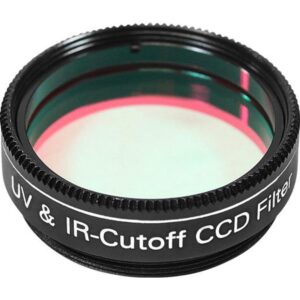
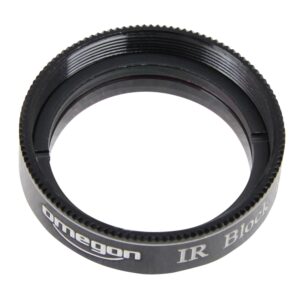
Showing all 4 resultsSorted by popularity
Corrective Filters: UV/IR-Cut for Superior Image Sharpness
In the world of digital astronomy, what we not are often the biggest enemy of a sharp image. A UV/IR-cut filter is an essential corrective filter that blocks invisible ultraviolet (UV) and infrared (IR) light. While the human eye does not perceive this light, camera sensors (CMOS/CCD) are extremely sensitive to it. Without a corrective filter from brands like Bresser, Explore Scientific or Omegon This invisible light causes “star bloating,” which makes stars appear blurry and swollen, obscuring fine details in your image.
At Telescoop.nl, we select filters with a steep transmission curve: they let 99% of the visible spectrum through, but mercilessly cut off the harmful wavelengths beyond it.
Why a UV/IR-cut filter is indispensable
Digital sensors capture light that lies outside our natural range. This leads to specific optical problems that can only be solved with a corrective filter:
Elimination of Chromatic Aberration: Infrared light refracts differently than visible light. In refractors (lens telescopes), this causes purple or red halos around bright stars. A UV/IR-cut filter restores color neutrality.
Protecting Your Sensor: In addition to optical correction, a 1.25″ or 2″ filter acts as a physical barrier against dust and moisture for your valuable camera sensor or the inside of your Barlow lens.
Sharper Planetary Details When filming planets (lucky imaging), blocking IR light results in a steadier image and more contrast on the surface structures of Mars or Jupiter.
Optical precision in your system
You will find these filters under telescope-accessories/correcting-filters-uv-ir-cut/.
Within our range of telescope accessories take a unique position. They are the bridge between your eyepieces and barlows and your recording equipment. At Telescoop.nl we understand that a correction filter Explore Scientific or Omegon lays the foundation for every quality photograph. This deep categorization ensures that the demanding photographer can immediately find the technical solution for chromatic aberrations and sensor artifacts.
Technical specifications and compatibility
A corrective filter must seamlessly integrate into your existing setup. When making your choice, consider the following parameters:
The Sizing (1.25 inch): Most astronomical cameras and eyepieces use the standard 1.25 inches Filter thread. Our filters of Bresser, Omegon and Explore Scientific are universally interchangeable and fit directly onto the nosepieces of your camera or barlow.
Optical Flatness Because a correction filter is often placed very close to the sensor, the flatness of the glass is crucial. We exclusively offer filters with optically polished glass to prevent internal reflections and ghosting.
Light transmission A professional UV/IR-cut filter should not affect exposure time. Our selection guarantees maximum transmission in the visible spectrum (400nm – 700nm), including the important H-alpha line.
Expert advice: When do you need this?
Are you using a color camera (OSC) or a modified DSLR without a built-in filter? Then a UV/IR-cut filter from Explore Scientific or Omegon your first priority. Even when using a Barlow lens, this filter helps to maximize sharpness on the axis of the image. Do you have doubts whether your specific telescope will benefit from an extra correcting filter? Ask us. We have the data to tell you exactly where the gain in image sharpness lies.
 Dutch
Dutch English