
Off-Axis Guiders & Camera Rotators
Showing 13–13 of 13 resultsSorted by popularity
Showing 13–13 of 13 resultsSorted by popularity
The function of an Off-Axis Guider (OAG)
A Off-Axis Guider is an instrument that is placed in the light path of the main telescope, just before the primary camera. Using a small prism, a fraction of the light at the edge of the field of view is deflected to a second, smaller camera: the guide camera. This allows the photographer to ‘guide’ using the focal length of the main telescope itself, without the need for an additional guide scope.
Preventing differential flexure
The biggest advantage of a OAG is eliminating differential flexure. With a separate guide scope, even minute mechanical deflections between the two telescopes can cause star blurriness, even if the guide scope is tracking perfectly. Because an OAG uses the exact same optical path as the main sensor, all telescope movements are corrected directly. This is particularly crucial for long focal length systems, such as Schmidt-Cassegrains and large RC telescopes.
Camera Rotators for Framing
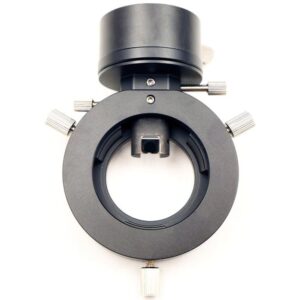
A camera rotator is used to change the orientation of the camera sensor relative to the celestial object. This is essential for proper framing of elongated objects like nebulae or galaxies. When using an OAG, a rotator is often desirable to find a suitable guide star without disturbing the composition of the main subject. Manual rotators must have a locking mechanism that does not induce tilt in the optical train.
Luminosity and prism dimensions
When choosing a OAG is the size of the prism important. A larger prism captures more light and offers a larger field of view for guide stars, which is an advantage especially with modern high-resolution sensors. In addition, the thickness of the OAG (the optical path) to fit within the system's available back-focus, as it takes up space between the telescope and the camera.
 Dutch
Dutch English