
Electronic Focusers
Showing all 6 resultsSorted by popularity
Showing all 6 resultsSorted by popularity
The function of an electronic focusing motor
A electronic focusing motor (EAF) automates the movement of the focuser on a telescope. In astrophotography, the slightest touch of the telescope is enough to cause vibrations that interfere with focusing. By controlling the focuser with a motor via software, manual operation is eliminated. This results in a more stable image and more precise control of sensor position.
Temperature compensation and focus drift
During the night, the ambient temperature changes, which affects the expansion and contraction of the telescope tube. This causes the focal point (focus shift) to shift. Electronic focus motors can be linked to temperature sensors. The software then calculates the necessary corrections and automatically moves the motor to keep the stars in focus throughout the session.
Autofocus and software integration
Combined with software such as N.I.N.A., SGP or EKOS, an electronic focuser can perform an autofocus run. The software analyzes the HFR (Half Flux Radius) of the stars and uses a ‘V-curve’ to determine the exact position of the best focus. This process is many times more accurate than what can be observed with the naked eye on a screen.
Mechanical assembly
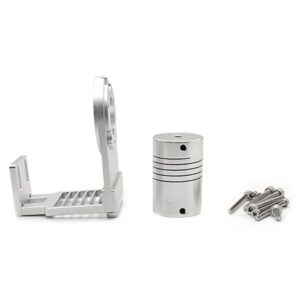
Most focus motors are universally designed and attach directly to the shaft of the existing focuser with a mounting bracket and coupling. This replaces the manual dials (both coarse and fine 1:10 delay). When choosing a focus motor, it is important to pay attention to the torque (power) of the motor, especially with heavy camera setups facing vertically upward.
 Dutch
Dutch English